FOMOfeed Website (2019)
Building a comprehensive website for one of NYC’s biggest art influencers
︎ fomofeed.com
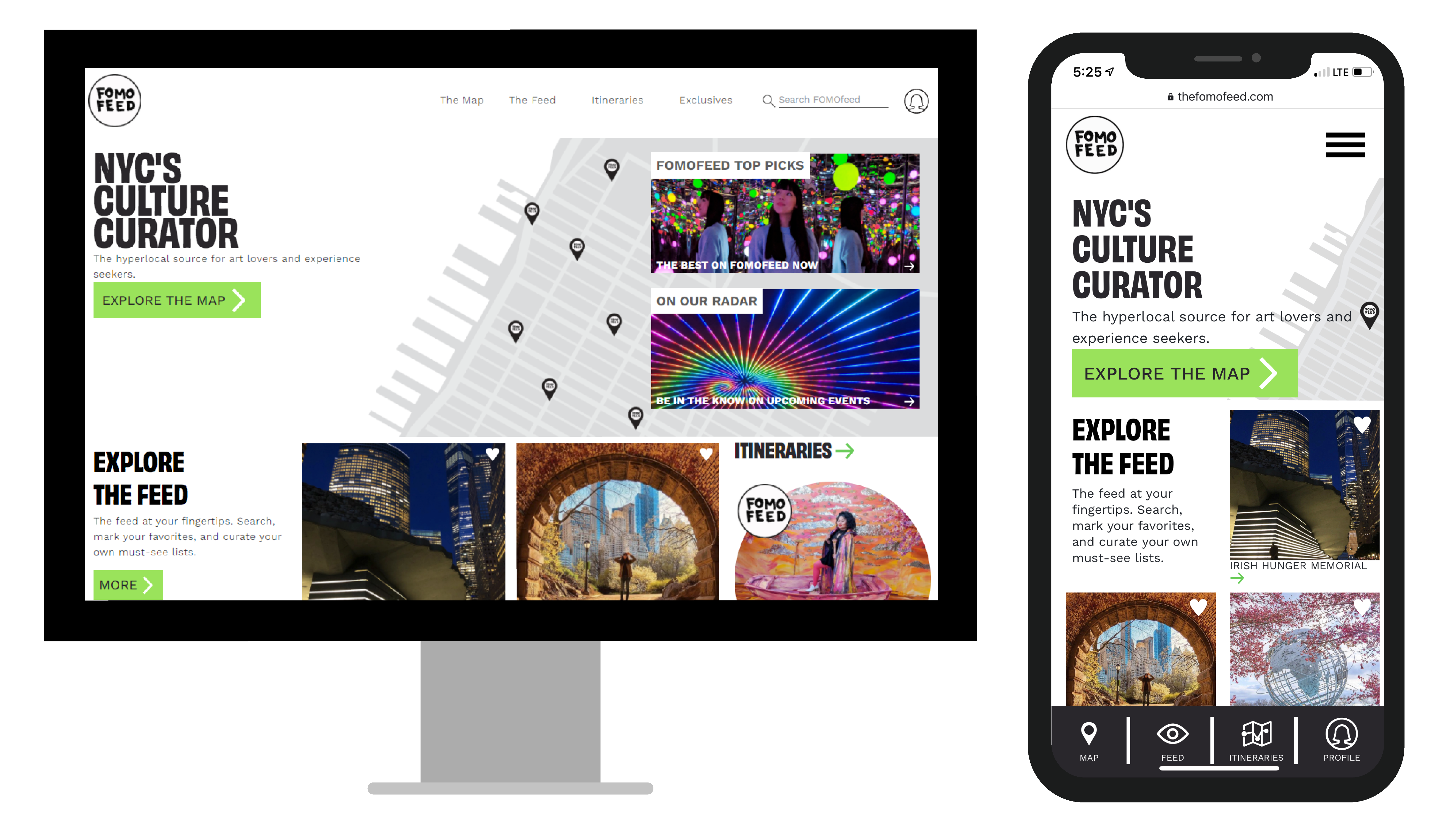
FOMOfeed is a business that originated on Instagram as a source for art and cultural happenings in New York City. With over 165K followers on Instagram, their content highlights new and Instagrammable locations for followers to go visit. I began working with their team because they were looking for a new digital way to strengthen their connection to followers off Instagram. The website we designed and I built extends the content of their Instagram with features like maps, saveability, itineraries and searchability.
What got me excited about working with FOMOfeed was the opportunity to leverage what I learned from Art Pigeon while continuing to build software that gets people exploring the city.

Deciding What to Build
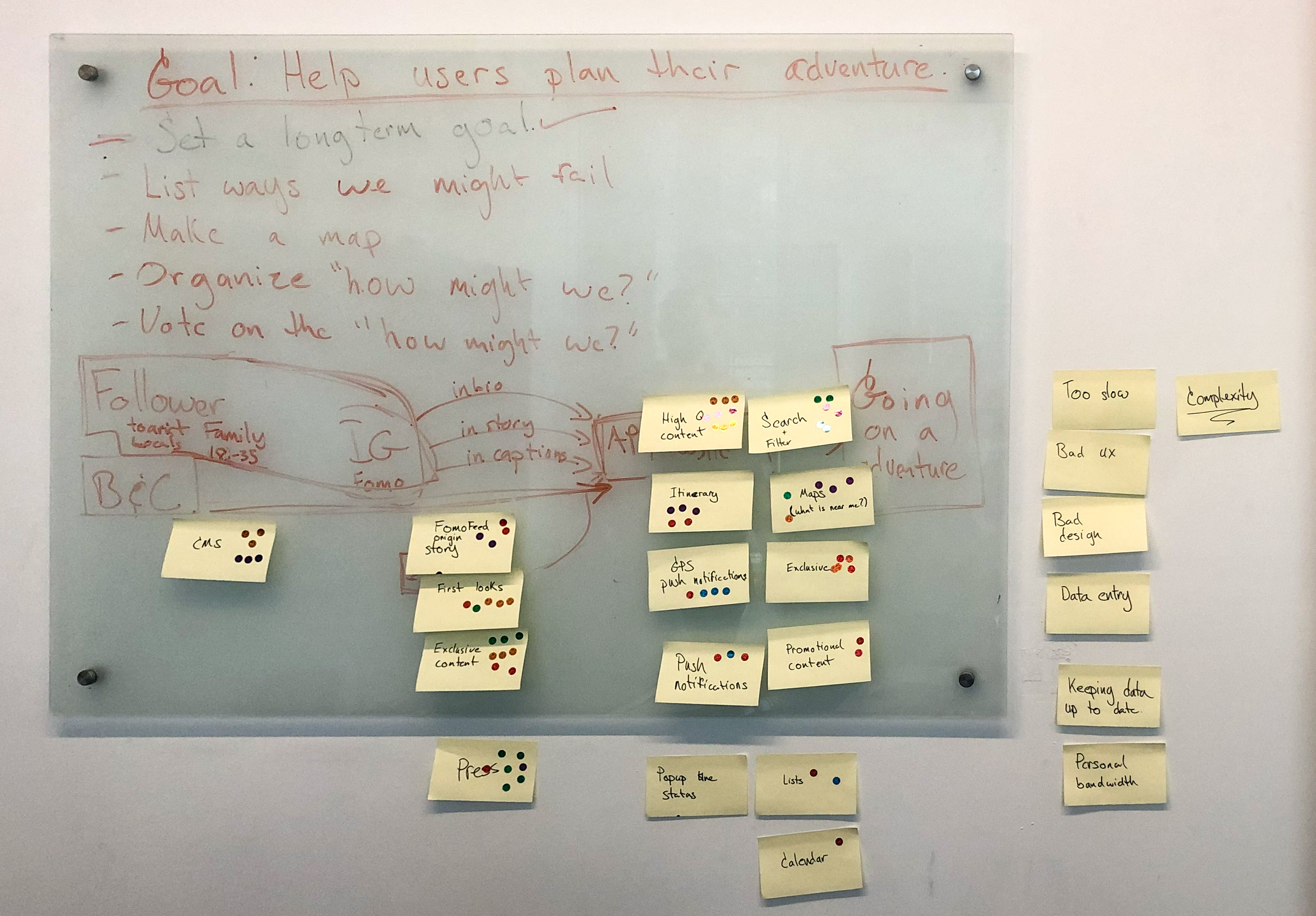
Before building anything I ran a Design Sprint with their team to figure out more precisely what I should build. Their team was looking to grow the business by becoming the default way people plan their outings and adventures in the city.
The Sprint process guided us to the consensus that a website was the best type of digital product to build. The website needed to provide a select number of functions for its users while also generating new streams of revenue for the business.
The Sprint process guided us to the consensus that a website was the best type of digital product to build. The website needed to provide a select number of functions for its users while also generating new streams of revenue for the business.
Direct to Instagram Backen Tool
In addition to serving users, the content management system for this web app also needed to integrate neatly into the existing workflows of their team. Having to enter event information for an Instagram caption and then again on their website was going to create too much hassle for the team; they are going to multiple events throughout the city each day and don’t have that kind of time and bandwidth to spare.
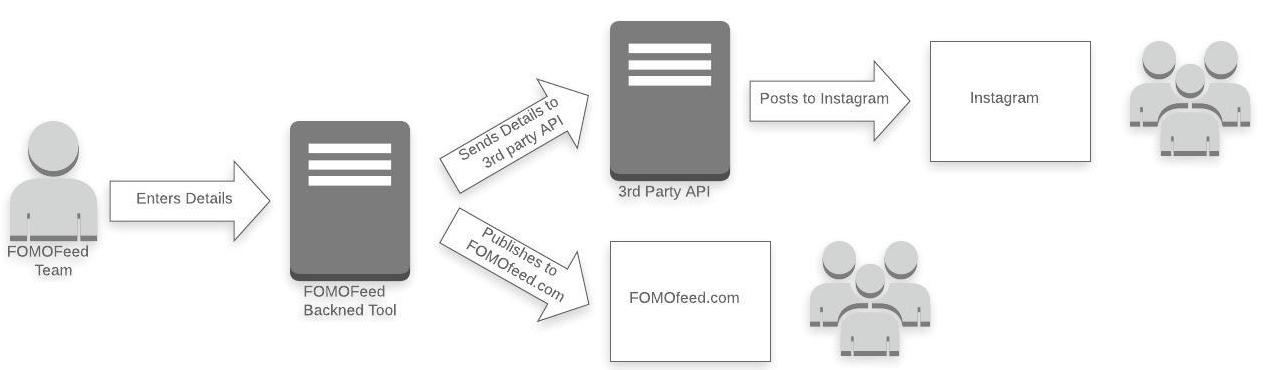
To streamline the FOMOfeed team’s workflow I built them a backend tool in which they only need to enter the structured information about an event (location, time, artists, etc.). From that data the backend tool will create a corresponding page on their site, format an Instagram caption, and then post that info to Instagram via a third party API.
Maps
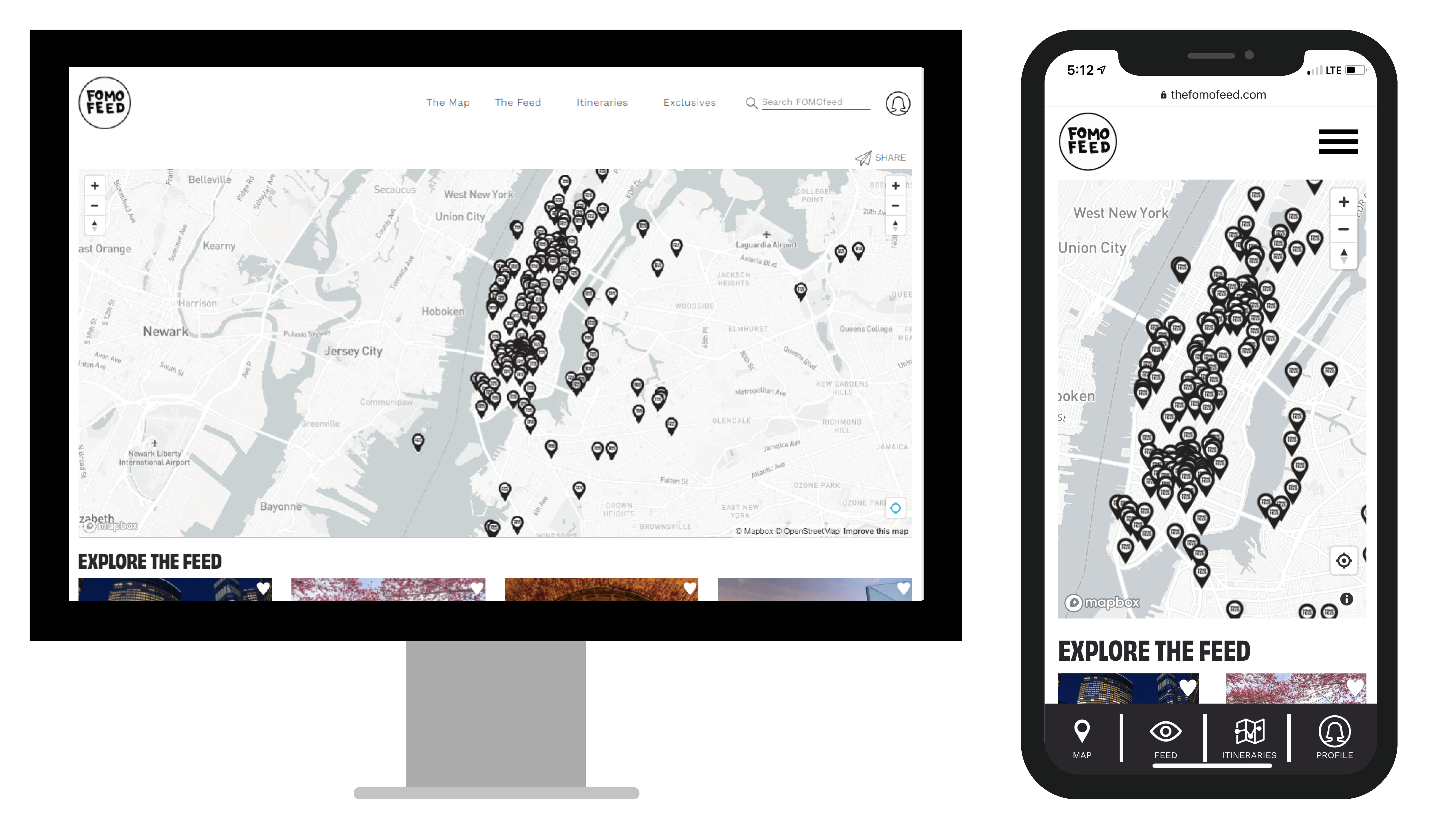
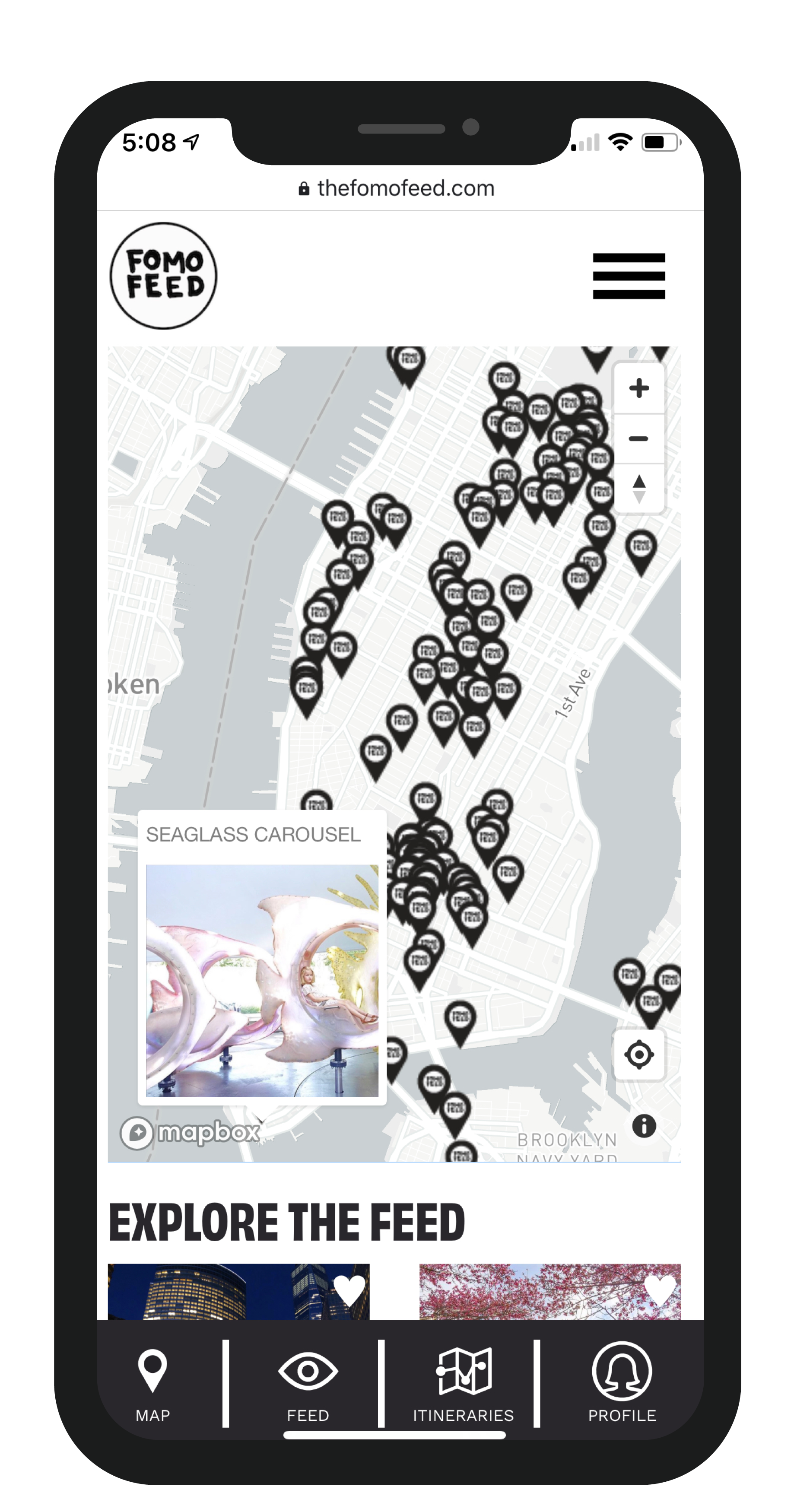
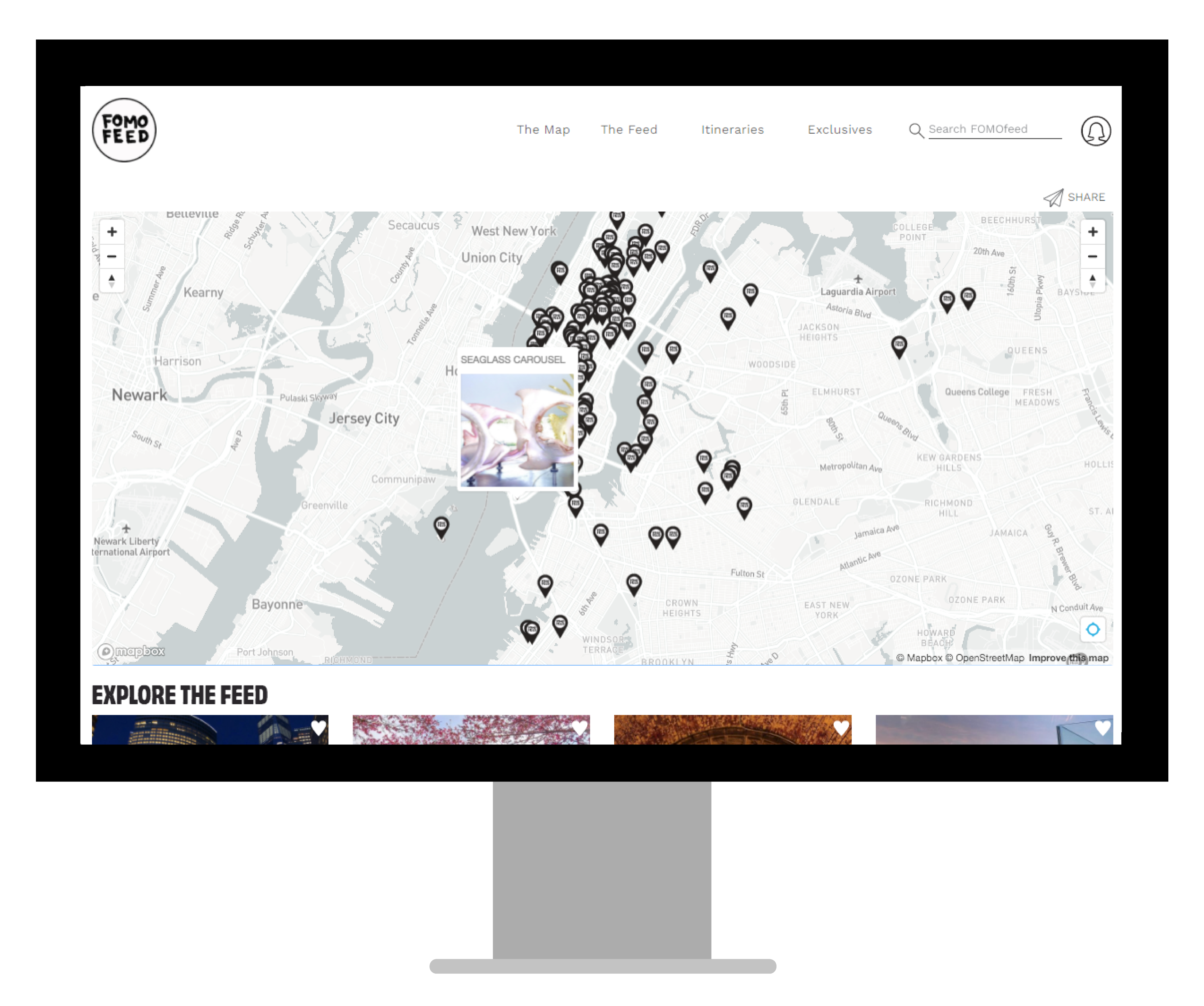
For FOMOfeed followers on Instagram a consistent issue was finding what activities were actually near them. Mapping the existing content of their Instagram feed deeply enriched that information so that users could easily find the activities near them. This meant a map needed to be built for all possible ways activities could be displayed; maps for itinerary pages, for search results, and for the feed itself.
There was a lot of debate over whether to use the well proven and more expensive map framework offered by Google or use the lesser known and more affordable service offered by MapBox. In the end we went with Mapbox because their features matched Google’s.
There was a lot of debate over whether to use the well proven and more expensive map framework offered by Google or use the lesser known and more affordable service offered by MapBox. In the end we went with Mapbox because their features matched Google’s.
Searchability
Another need FOMOfeed followers seemed to have was the ability filter through the many Instagram posts to find a specific type of activity. We needed a way for users to be able to filter for things such as free events.Making the FOMOfeed content searchable meant building a mini search engine to look through each activity's hashtags. The results is a powerful tool that allows users to search for specifics like good food spots or the nearest free activities.
Making the Most Out of Our Data
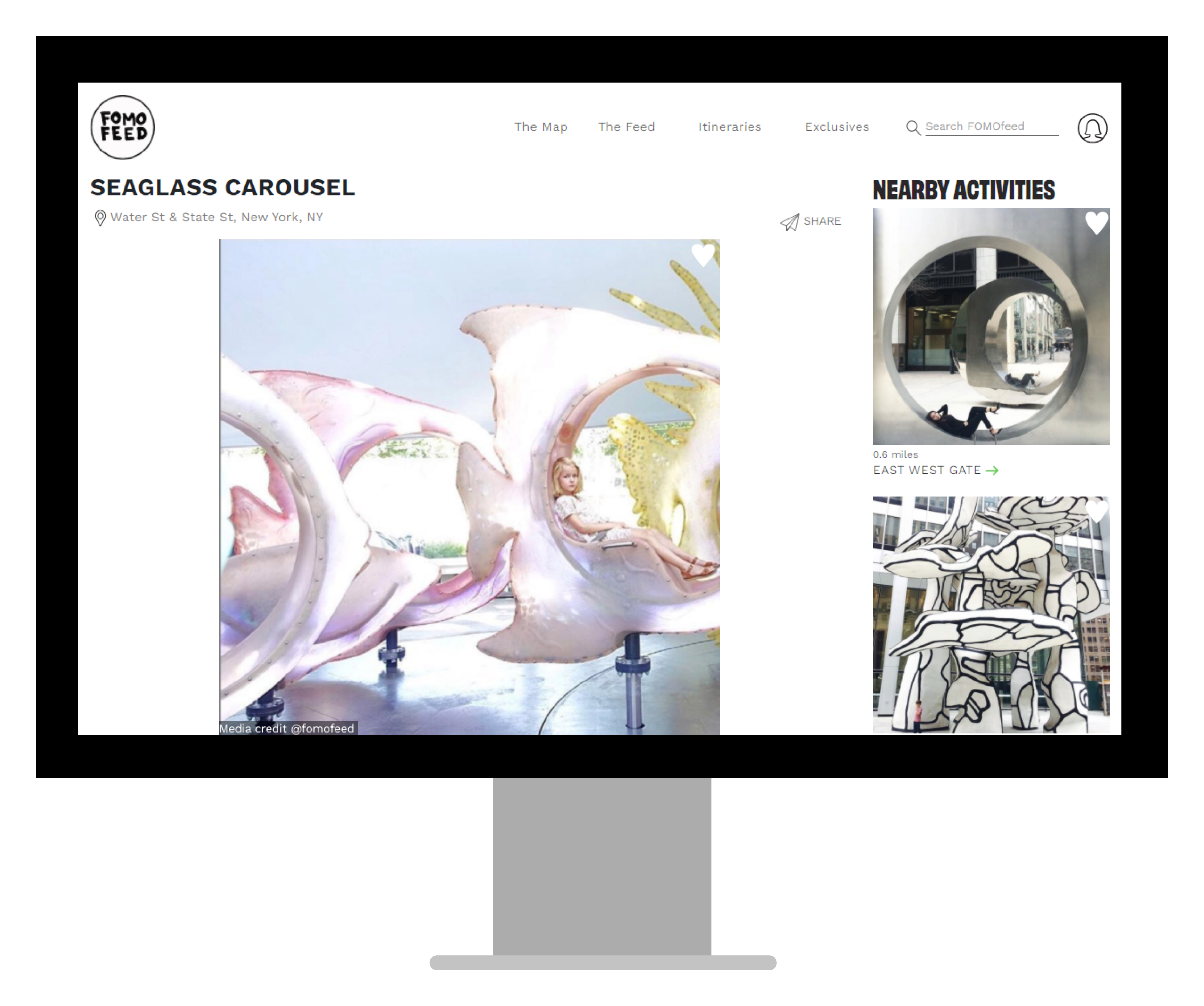
The content on any given event page is generated from the same data that is also included in each Instagram post. So to make the website worth the user's time we needed to have features that would make the webpage for an activity inherently more valuable than the Instagram post. Things like nearby activities, related activities and quick access to directions in google maps combine to give the user more value than a simple Instagram post.
![]()
![]()
The content on any given event page is generated from the same data that is also included in each Instagram post. So to make the website worth the user's time we needed to have features that would make the webpage for an activity inherently more valuable than the Instagram post. Things like nearby activities, related activities and quick access to directions in google maps combine to give the user more value than a simple Instagram post.

Favorites
As part of our overall goal to more deeply engage FOMOfeed followers we created the ability for users to make itineraries of their own. These are essentially pages that include activities the user has favorited. Allowing registered users to organize activities into their own groupings seemed like a logical starting for building a more feature rich platform with more user to user interactions.
Itineraries
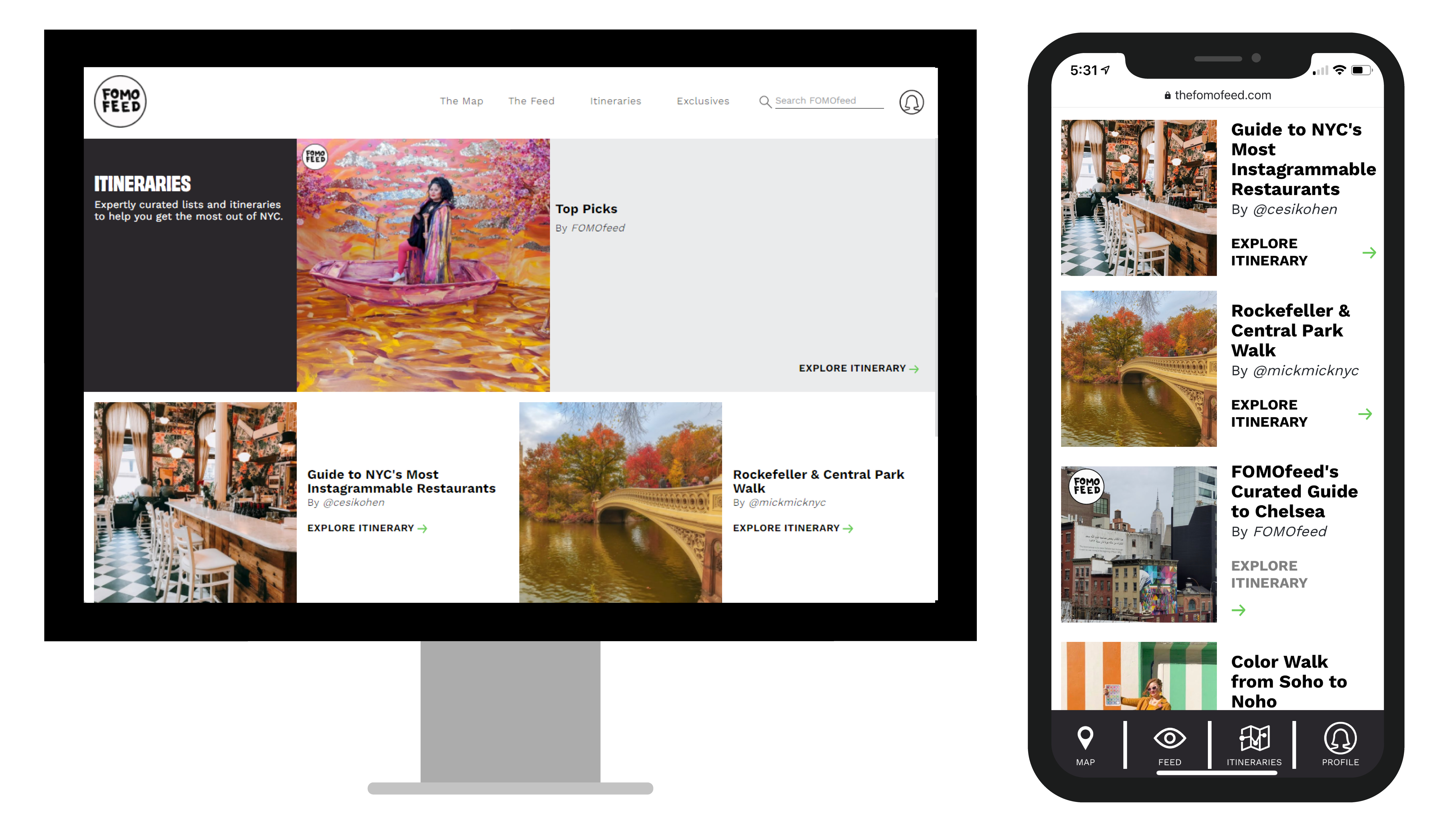
Another way FOMOfeed was able to capture more value from the same content is simply arranging existing content into itineraries for specific areas of interest. These are essential neighborhood guides and listicles that help to further exemplify FOMOfeed expertise and give users more ways to explore the city.
![]()
![]()
Another way FOMOfeed was able to capture more value from the same content is simply arranging existing content into itineraries for specific areas of interest. These are essential neighborhood guides and listicles that help to further exemplify FOMOfeed expertise and give users more ways to explore the city.


Infrastructure
- Backend: Django
- Front end: Standard HTML and jQuery
- Web scraping: Beautiful Soup
- Databases: postgres
- Static storage: AWS
- Image handling: Cloudinary
- Deployment: Docker deployed on Heroku
Art Pigeon (2018 - 2019)
Building an app, website, and business to help others discover public art.
Art Pigeon began in 2018 with my own desire to map New York Cities public art. It is the website and app that I built as well as the Instagram account I grew.
The platform is dedicated to being the connector between creators of public art and consumers of public art. For creators, such as artists and arts organizations, it is a tool to promote new work and a platform to provide rich details about that work. For consumers, such as tourists and local art enthusiasts, it is a tool for finding and understanding public art.


Product
Art Pigeon’s core product is it’s database of outdoor sculptures and murals. By working with community members and art organizations, Art Pigeon has already collected information on over 700 artworks in NYC. Where traditional media views an artwork, a location, or an artist in isolation, Art Pigeon's aggregated data gives those subjects a richer and more engaging context.This wealth of information is made accessible and editable through a cross-platform app, website, and social media presence.
Growth and the Pigeon Persona
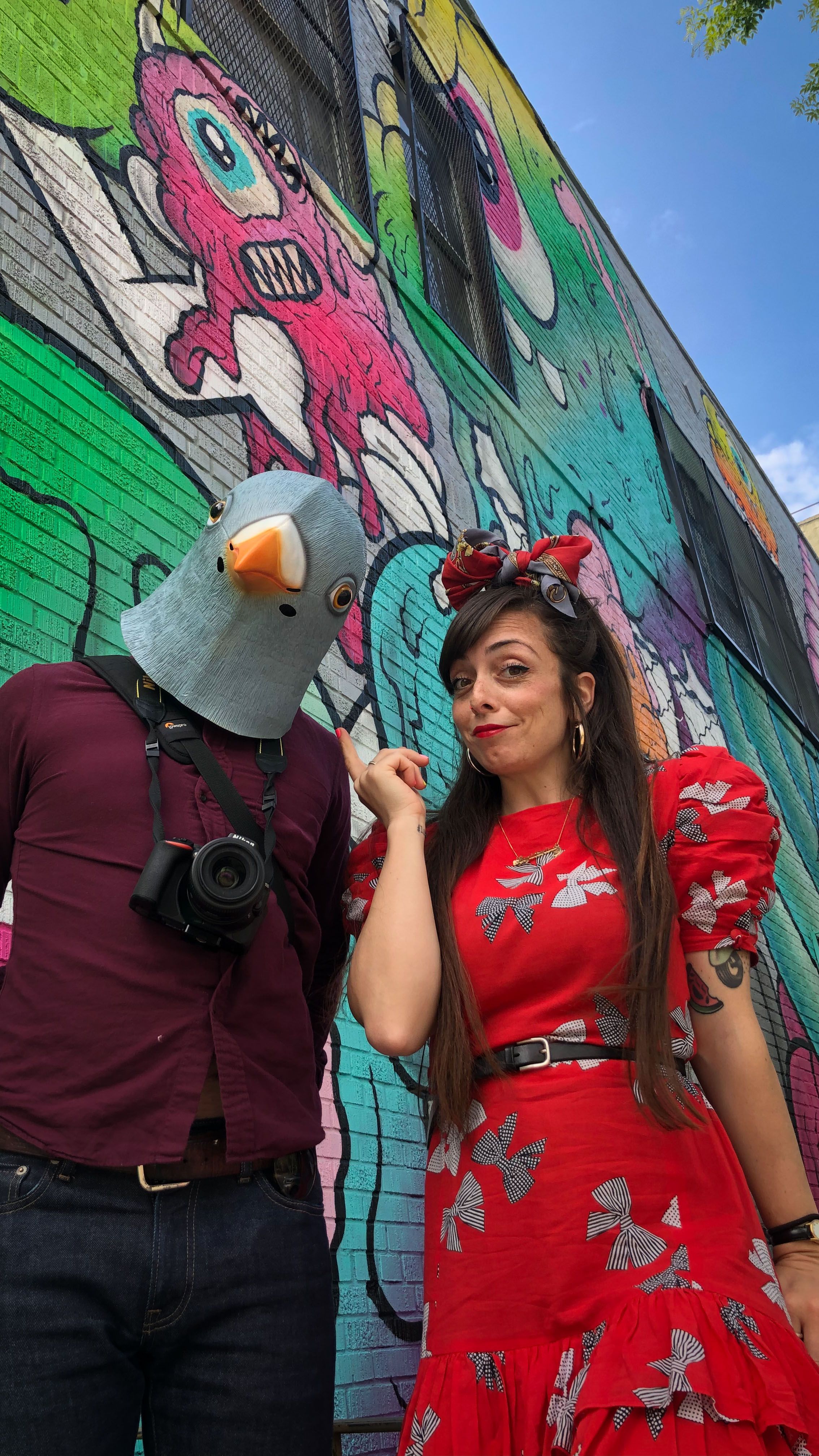
Art Pigeon grew through gorilla style fliers, content driven marketing on Instagram, and some paidadvertising on through Facebook. Most fun of all those methods was the development of the pigeon mascot and persona. As most of that persona existed in Instagram stories, little for documentation.
One piece of content that remains is this s
treet art walking tour I did with the Facebook Influencer Mickey Blank.
Amassing Content Via Web Scraping
From the start I knew Art Pigeon would need a significant collection of artworks in order to engage users. To kickstart the collection of that content I built a backend tool for scraping existing content from websites that already had already documented large amounts of public art; to start I scraped the MTA arts website and the NYC Parks Department site for data about the location, artist, and materials of the artwork. I then used the Bing image search AP and news search API to build upon that metadata so that each artwork would have additional images and news articles that were not included on their origin site.Collaborative Guides
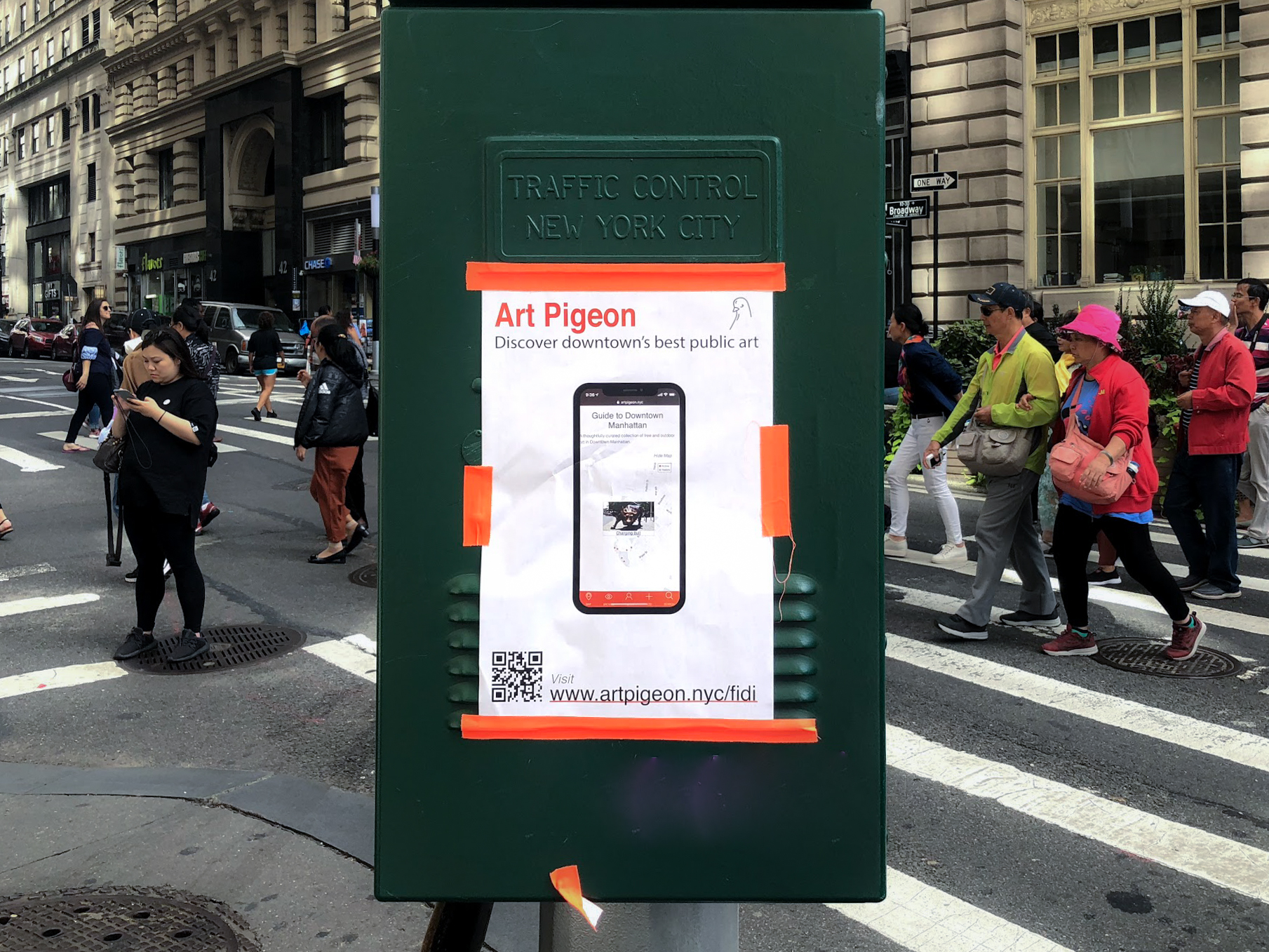
One of the most effective ways I found to grow Art Pigeon was to collaborate with Instagram influencers who already had a following in the public art space. These collaborations usually entailed creating a guide for the influencer within the Art app and website. The guide would include all their favorite pieces of public art and feature their photos as the main image.After the guide was created we would often create a giveaway with some merch to encourage folks to download the app or follow the Art Pigeon Instagram.


Data Loss
In what was the most painful mistake I can ever remember making, I accidentally deleted about 50% of all the Art Pigeon data.I had fortentianly downloaded one database backup onto a thumb drive right before launching the site. From that backup I was able to restore a lot of the website and app. It was a hard learned lesson in the importance of thorough and redundant data management.
Collaborating with The Other Art Fair
When the opportunity to partner with The Other Fair came about I jumped at the chance to join forces with another organization who shares our mis
sion to make art more accessible. Our collaboration consisted of a guide to the street around the fair as well as a free ticket to the fair hidden with the Art Pigeon app; users would shake their phone with our app open and a free ticket to the fair would appear on their screen. The giveaway landed Art Pigeon over a hundred downloads and lots of positive praise.
sion to make art more accessible. Our collaboration consisted of a guide to the street around the fair as well as a free ticket to the fair hidden with the Art Pigeon app; users would shake their phone with our app open and a free ticket to the fair would appear on their screen. The giveaway landed Art Pigeon over a hundred downloads and lots of positive praise.
Infrastructure
- Backend: Django
- Front end: Standard HTML and jQuery
- iOS and Android App: Cordova and Framework7
- Web scraping: Beautiful Soup
- Databases: postgres
- Static storage: AWS
- Image handling: Cloudinary
- Deployment: Docker deployed on Heroku
Medieval Communication (2014)
Visualizing Jewish history through the aggregate manuscripts of the Cairo Genizah
︎︎︎
Utilizing the advents of data science this project demonstrates a new methodology for studying the Cairo Genizah documents. Here is the first time this data set has been processed on such a comprehensive scale. The following interactive graphs are likely the first visualizations of the millennia old network contained within the Cairo Genizah.
Background
Treatment of God's Namen
In Jewish law the reverence for God extends to the written word and any document containing his name is never to be treated as trash. Many medieval correspondence would include a prayer and were thus never disposed of.
A Genizah
A Genizah is a storage space where texts and manuscripts that contain god’s name are stored after their useful life. This space for indefinite storage is often in a synagogue or cemetery.
The Cairo Genizah
The Jewish community of Fustat (present day Cairo, Egypt) amassed a collection of approximately 200,000 documents that remained relatively preserved in the arid desert climate. These documents provide an unfiltered history of Medieval Jewish people.
Along the way I realized the enormous potential of the unexplored structures contained in the Genizah documents. I subsequently reached out to the Mathematics department chair and set-up an independent study focused on using the tools of discrete mathematics to study the Genizah documents. I presented those results in a paper and later created this webpage to share my findings.
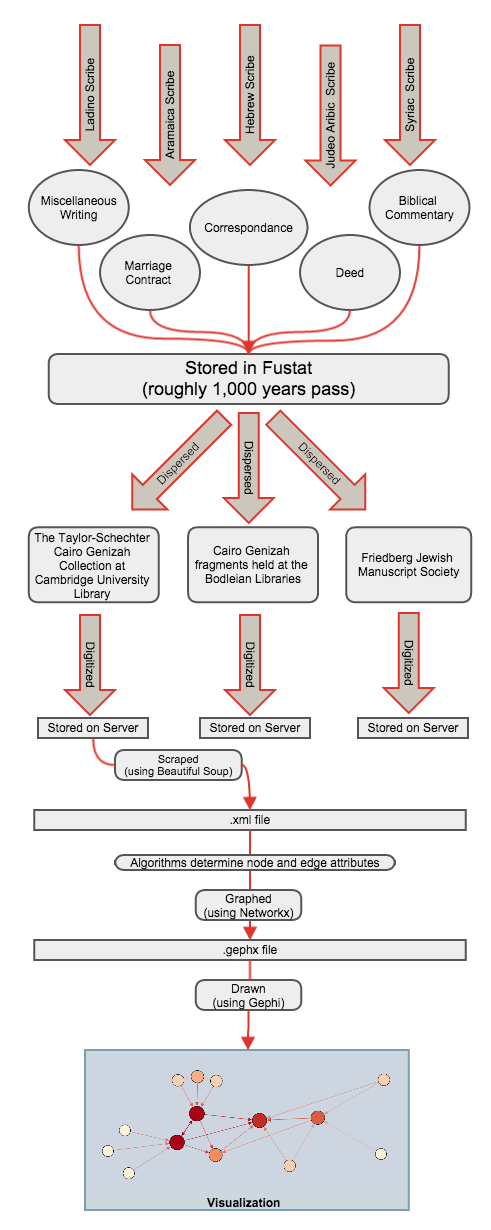
The basis for these networks was scribed thousands of years ago and since undergone many transformations. The steps of exchange, reformatting, and re-purposing of this data can be understood through the flow chart on the right.
Treatment of God's Namen
In Jewish law the reverence for God extends to the written word and any document containing his name is never to be treated as trash. Many medieval correspondence would include a prayer and were thus never disposed of.
A Genizah
A Genizah is a storage space where texts and manuscripts that contain god’s name are stored after their useful life. This space for indefinite storage is often in a synagogue or cemetery.
The Cairo Genizah
The Jewish community of Fustat (present day Cairo, Egypt) amassed a collection of approximately 200,000 documents that remained relatively preserved in the arid desert climate. These documents provide an unfiltered history of Medieval Jewish people.
My Approach
During my spring 2014 semester I took two inspiring classes in both discrete mathematics and the history of Jews living in Islamic lands. During that semester I became fascinated by the Cairo Genizah and the scholars who dedicated themselves studying it’s documents. At the same I was learning about the power and versatility of discrete mathematical structures.Along the way I realized the enormous potential of the unexplored structures contained in the Genizah documents. I subsequently reached out to the Mathematics department chair and set-up an independent study focused on using the tools of discrete mathematics to study the Genizah documents. I presented those results in a paper and later created this webpage to share my findings.
The basis for these networks was scribed thousands of years ago and since undergone many transformations. The steps of exchange, reformatting, and re-purposing of this data can be understood through the flow chart on the right.
Visualizing Avenues of Communication
In the following graph each edge represents a document with nodes corresponding to its author and addressee. To draw a graph that is both comprehensive and meaningful multiple algorithms used to optimize the graphs layout. comprehensive and meaningful.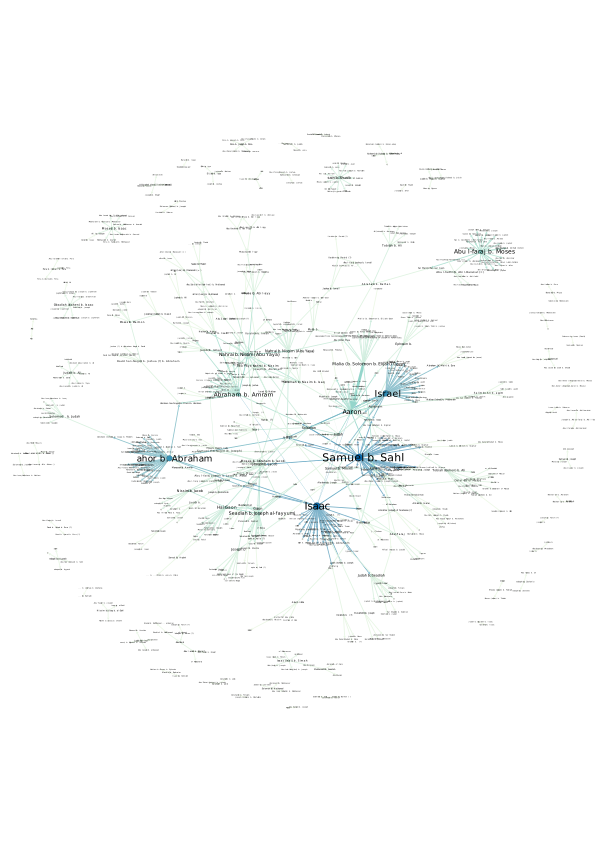
Building a House Boat (2010)
Designing, constructing, and living aboard a houseboat.
The Landlord Independent was a 40ft houseboat that was envisioned and created on the belief that the maritime environment is the ideal home for a sustainable artist community. In the spring of 2009, Zachary Weindel and I began a design process focused on repurposing disregarded materials for use in building our boat.
The collaborative process of imagining, planning, and building this vessel demanded that I learn new methods for managing a range of essential and unusual tasks. Building this boat taught me a great deal about the joys and challenges of managing multifaceted projects. The boats distinct phases of construction and the media coverage we garnered are documented here.
Life Aboard


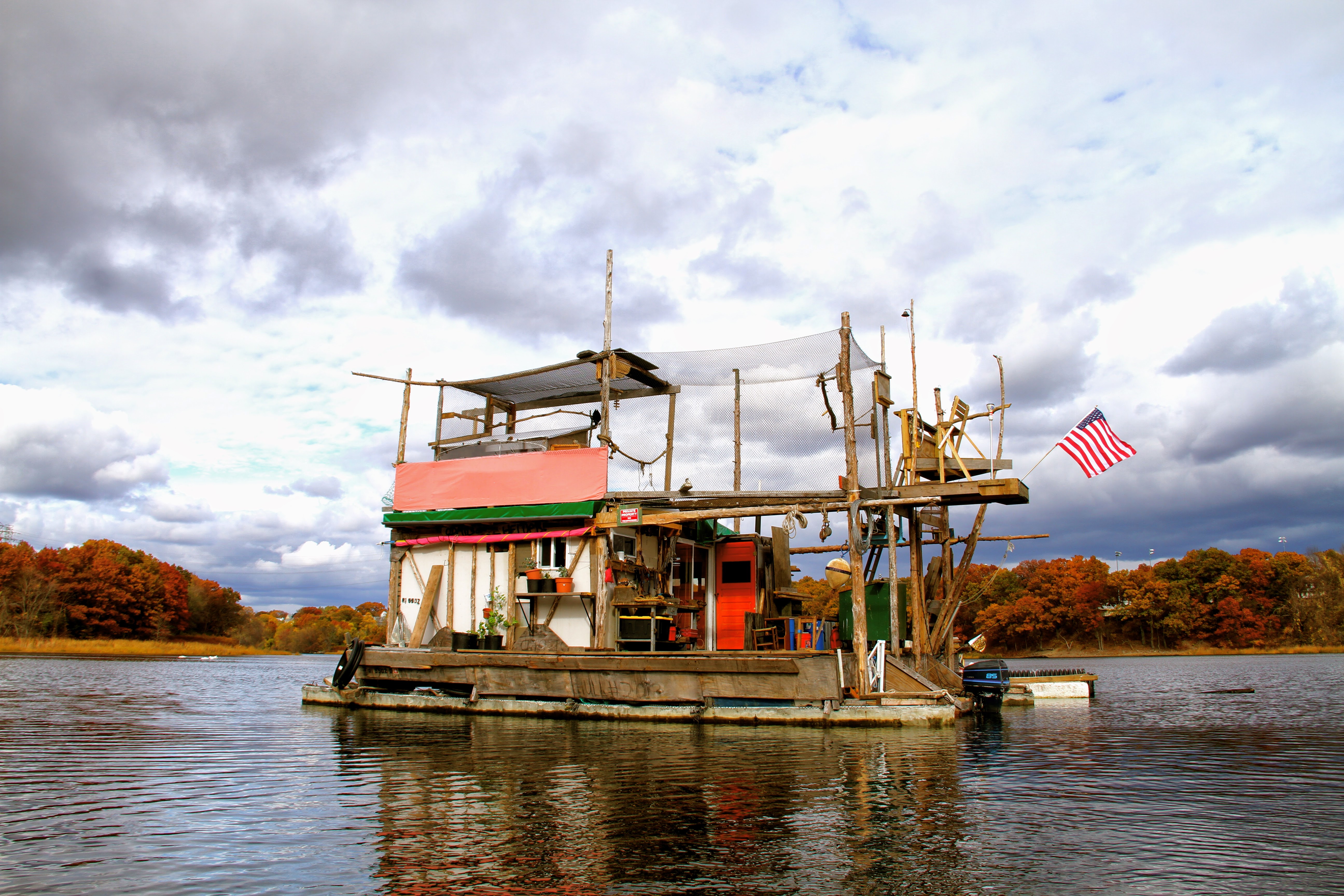


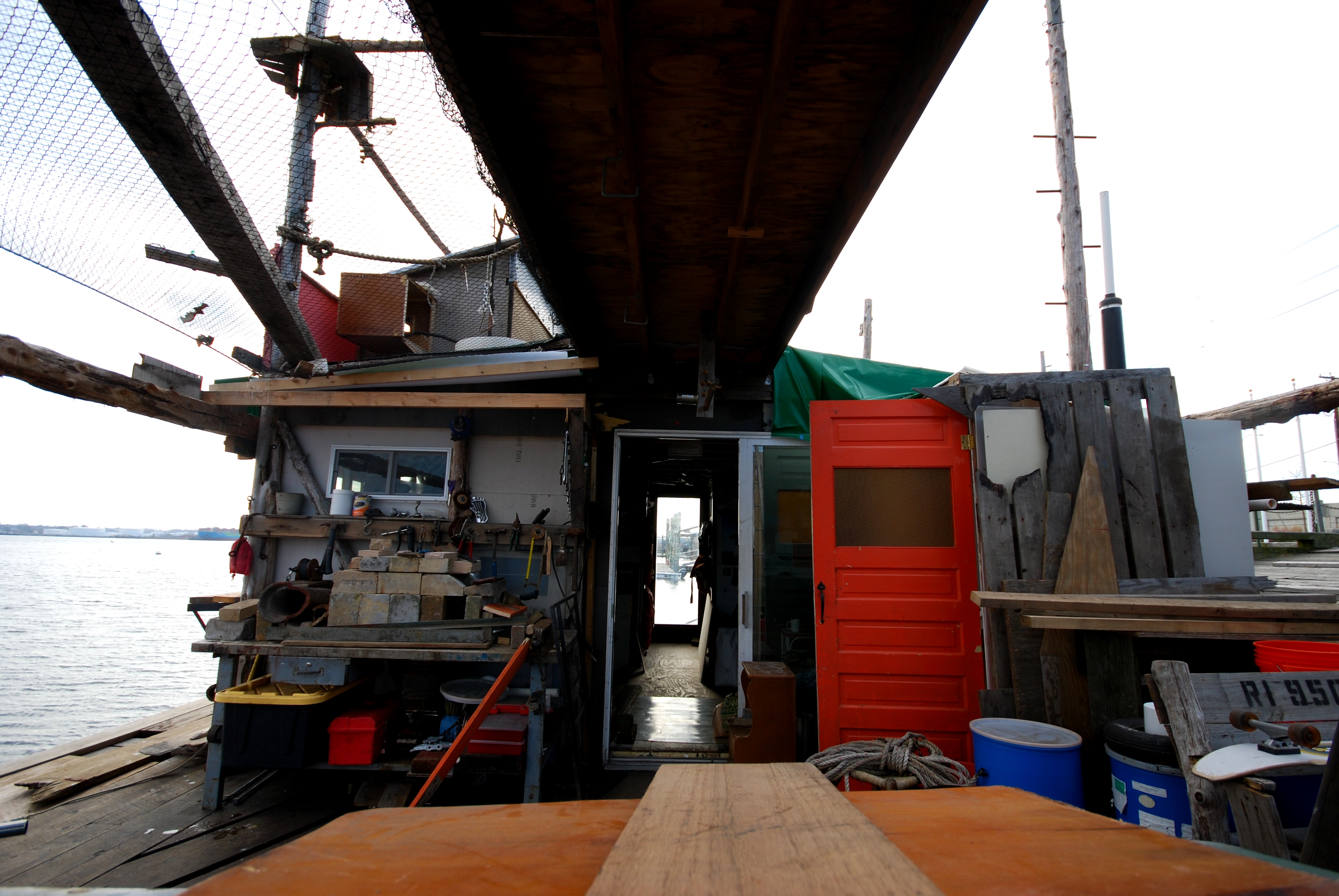


Living on the Landlord Independent provided a unique juxtaposition between a life in the city and home on the frontier. The boat found restage in the many hidden and beautiful oases which fill the waterways of Providence, Rhode Island. Doing without some domestic comforts seemed inconsequential when surrounded by the magnitude and beauty of the outside environment.
On board, summertime cookouts were a common occurrence with a revolving cast of friends, family, fishermen, and people from the community. All through the changing seasons of New England we would move the boat between a variety of more or less rural anchorages. Along the way, the houseboat drew the interests of spectators, friends, foes and allies. Opinions on the boat varied from eyesore to masterpiece.
Unequivocal among the Landlord Independent’s characteristics was the combined forward force of Zach and myself. It is a force defined by our unmatched ability to imagine, plan, and then build our own reality.
Building the Cabin




Cabin Materials
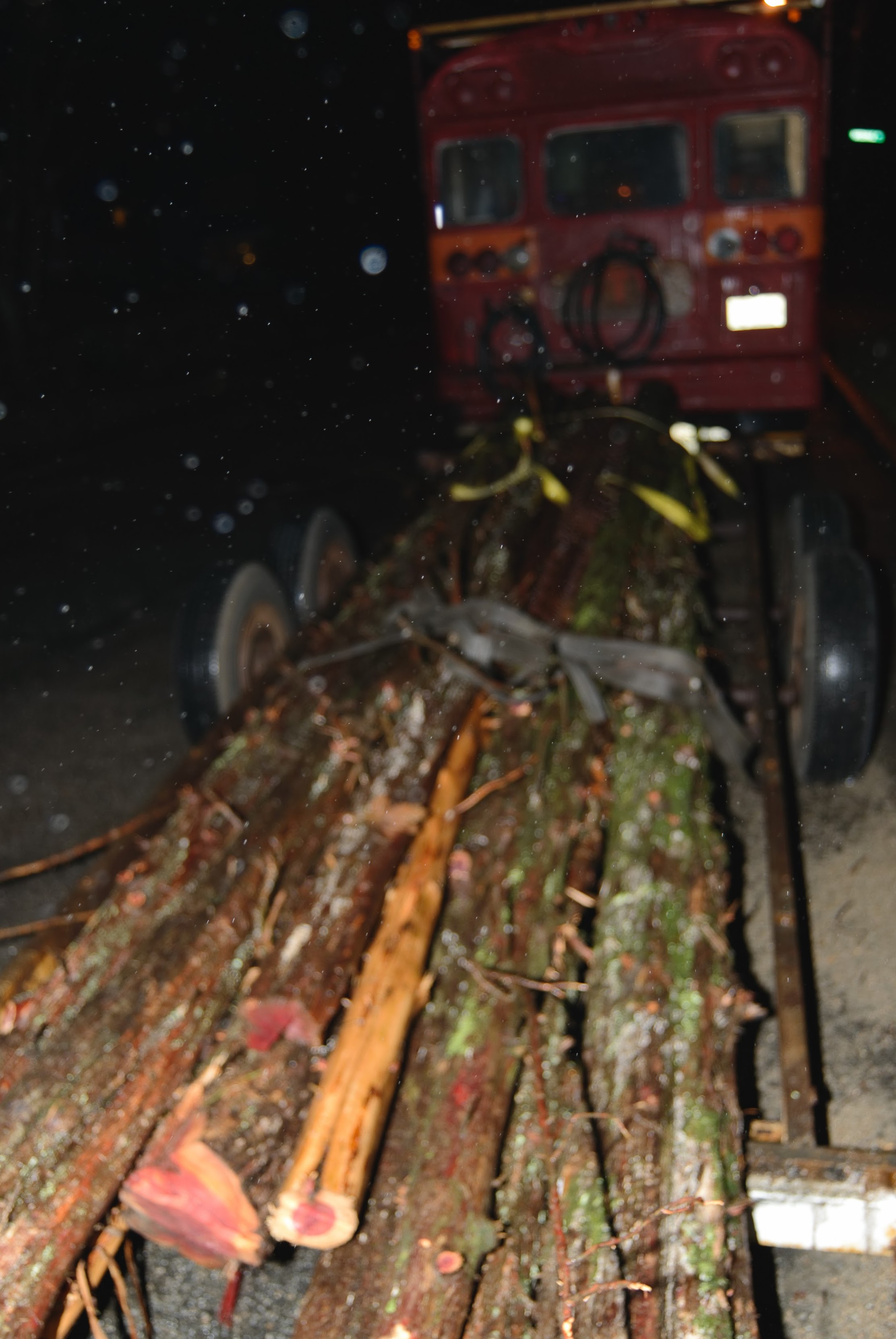
The framework of the boat’s cabin was built from of local cedar trees. On top of this framework a roof was constructed from foam panels that had been salvaged from a demolished ice warehouse. The walls were built from similar foam panels donated by a materials testing facility. Firebricks from the site of a former industrial furnace were used to build the boat’s wood stove.
Electrical System
The boat’s electric system included LED lights, a radio, and phone chargers. These light duty appliances drew power from three 12-volt deep cycle batteries wired in series. A wind turbine mounted with a custom charge controller was installed to keep this system charged.
The Vessel’s Anchor
The enormous surface area of the boat required an anchor with exceptional holding power. A custom anchor was welded from scraps of structural steel for this purpose.
Waste Treatment
A composting toilet was used for the treatment of waste. The contents of the toilet would quickly decompose for safe and environmental disposal on land.
Building the Deck
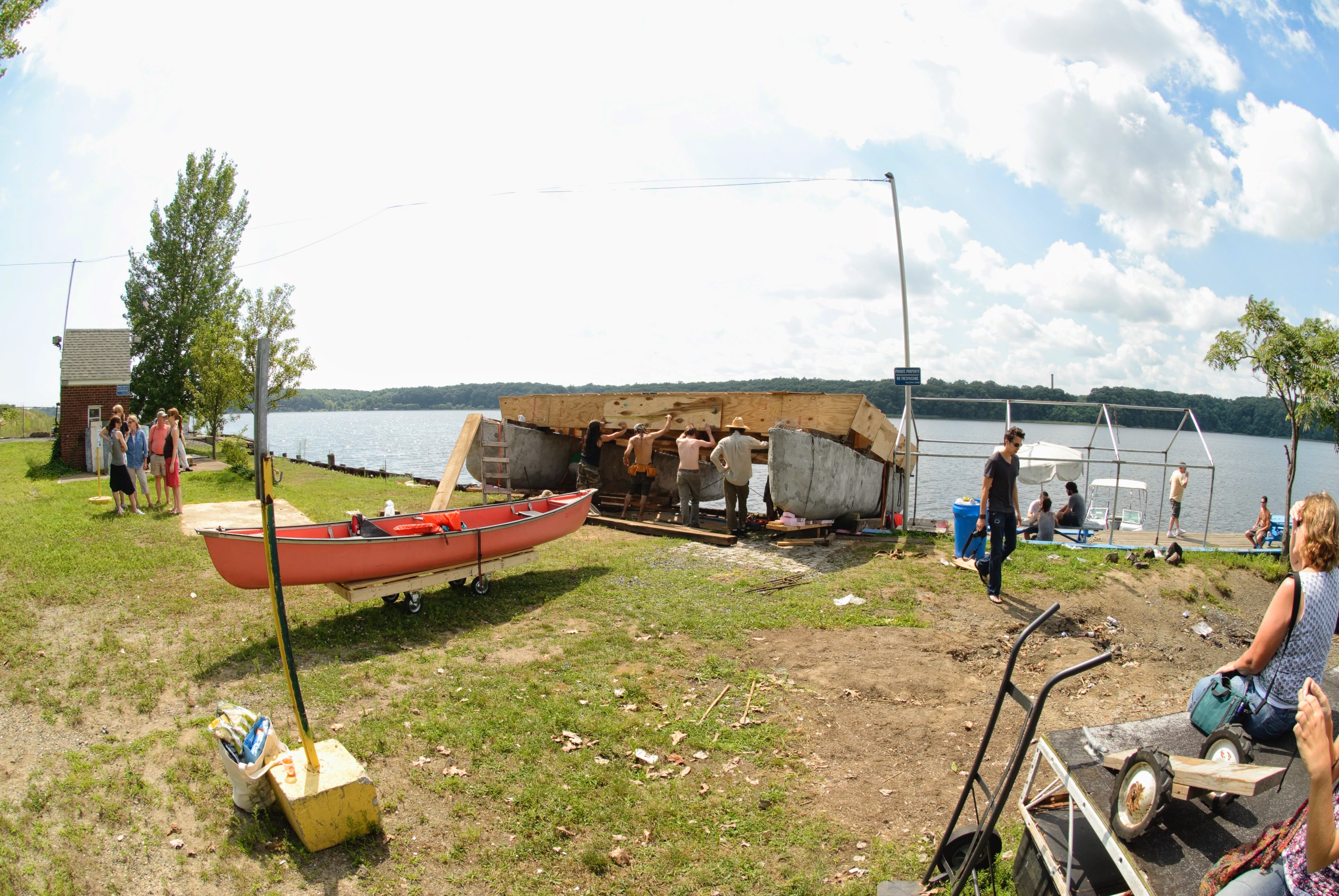
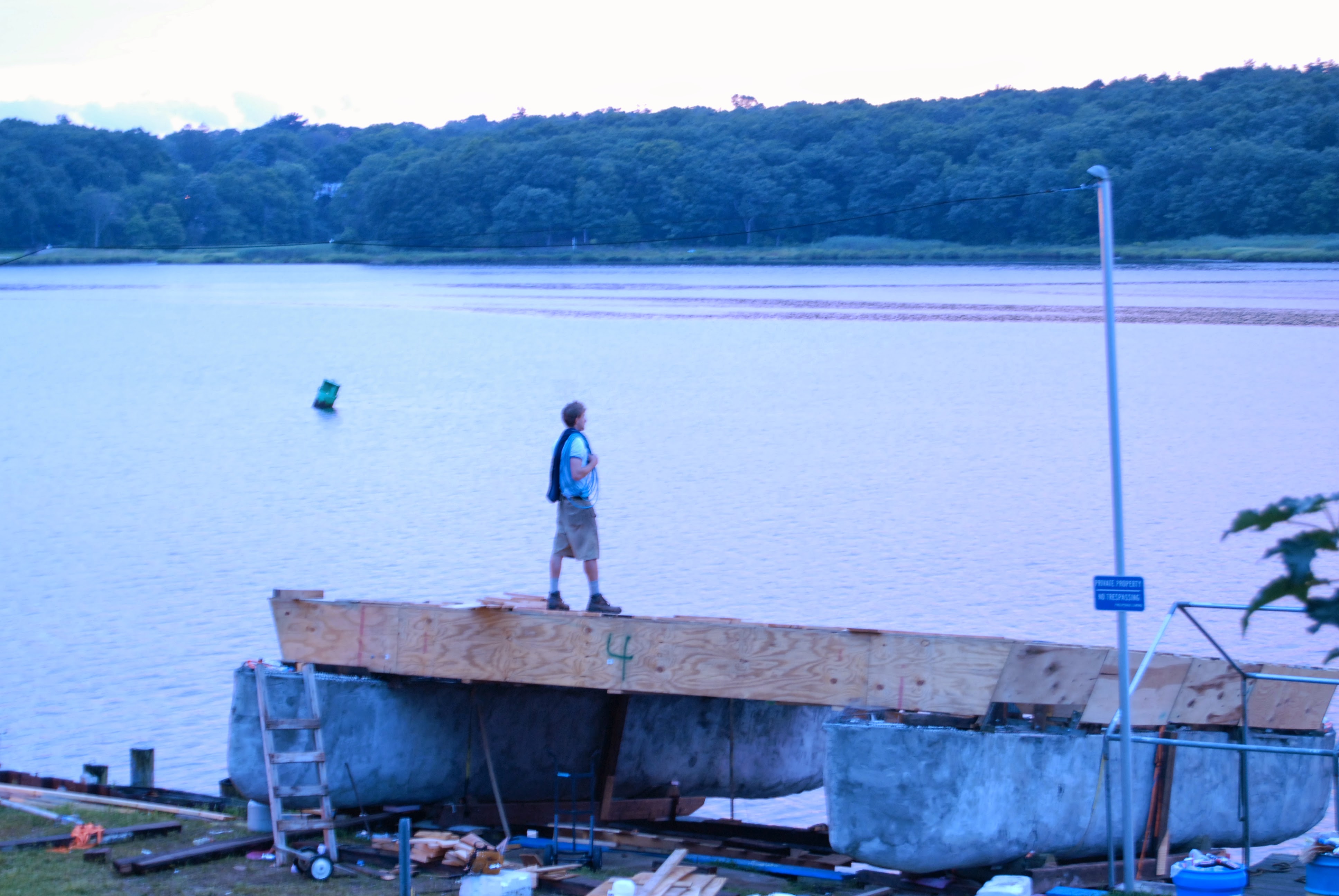


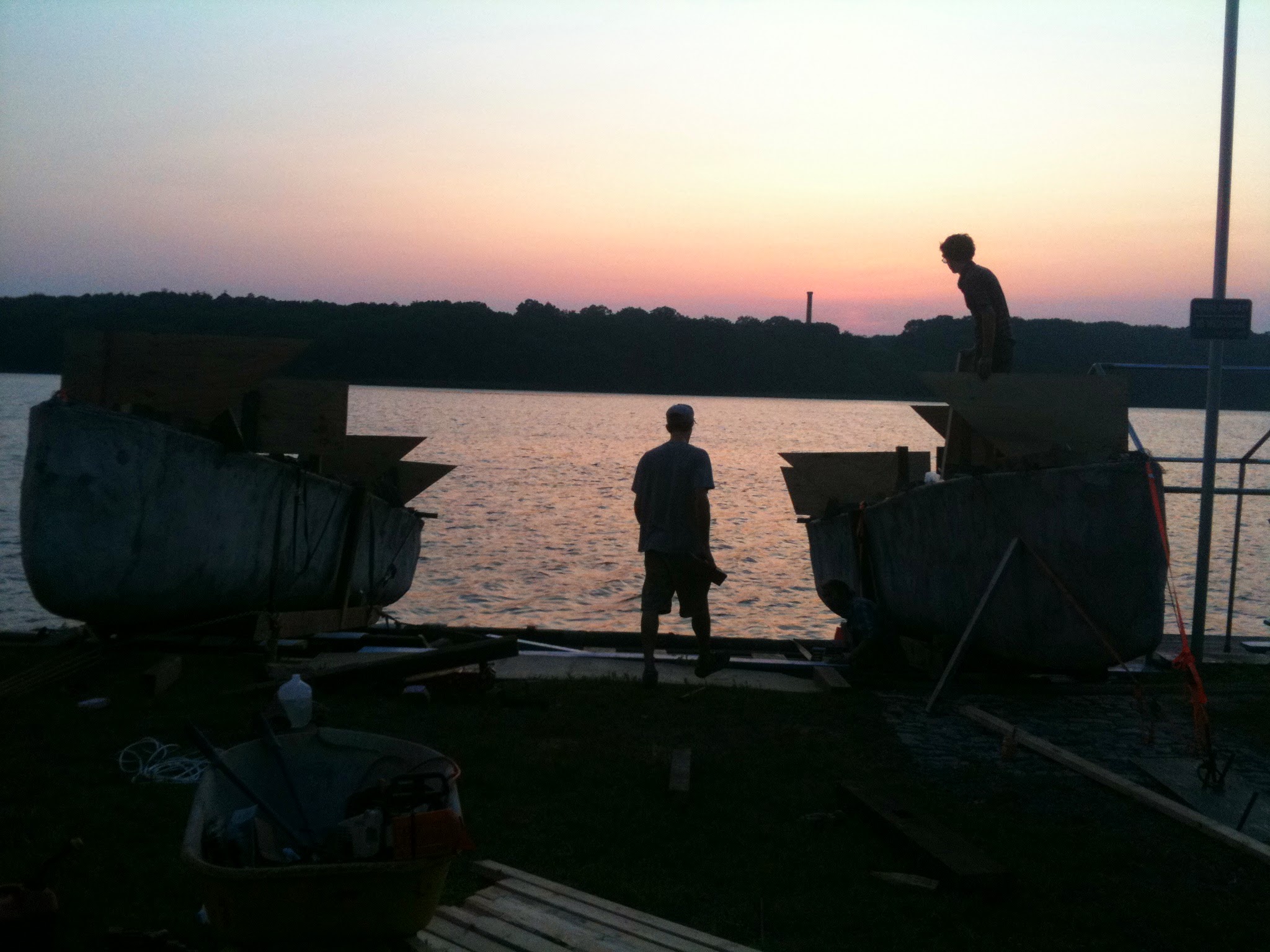
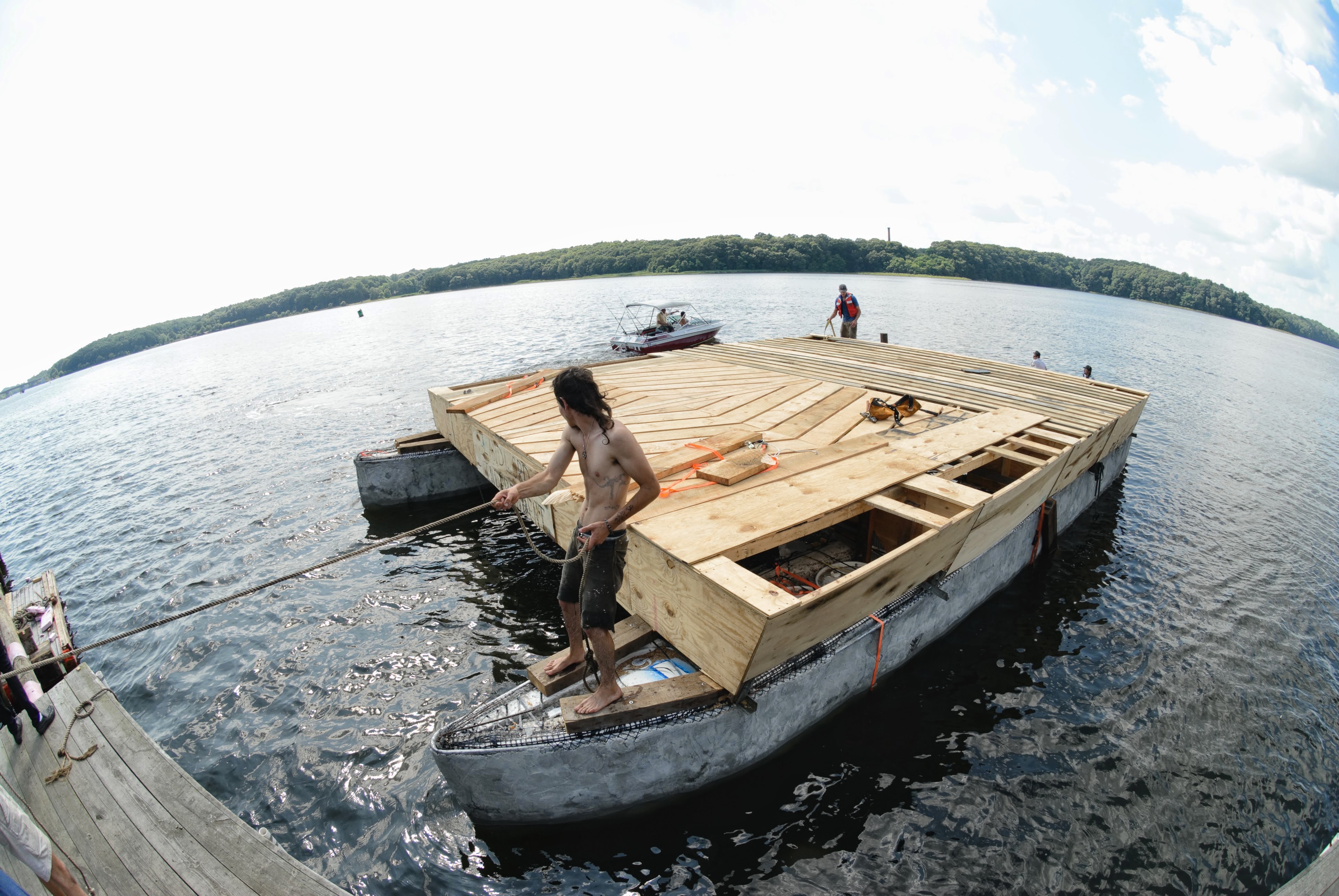
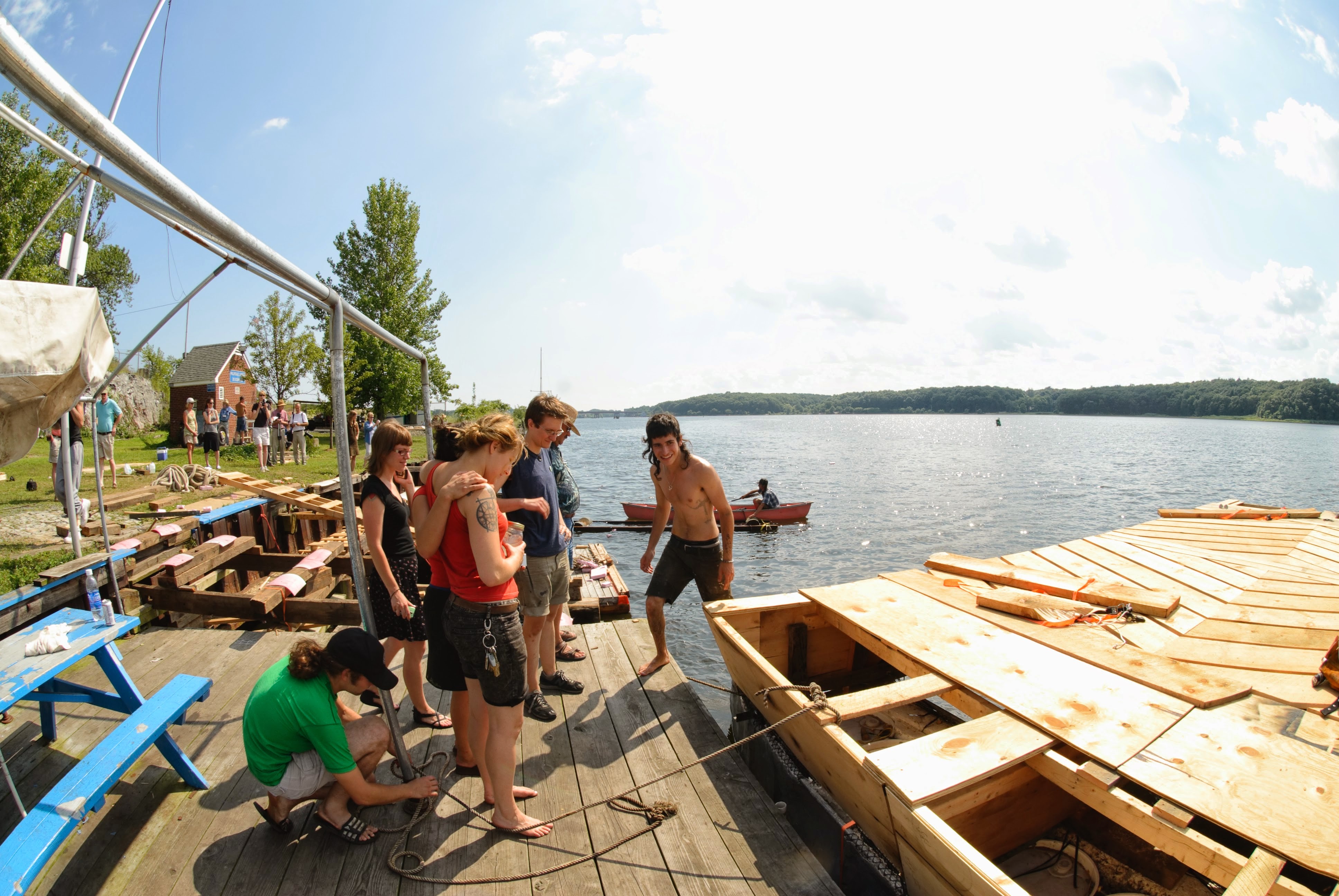


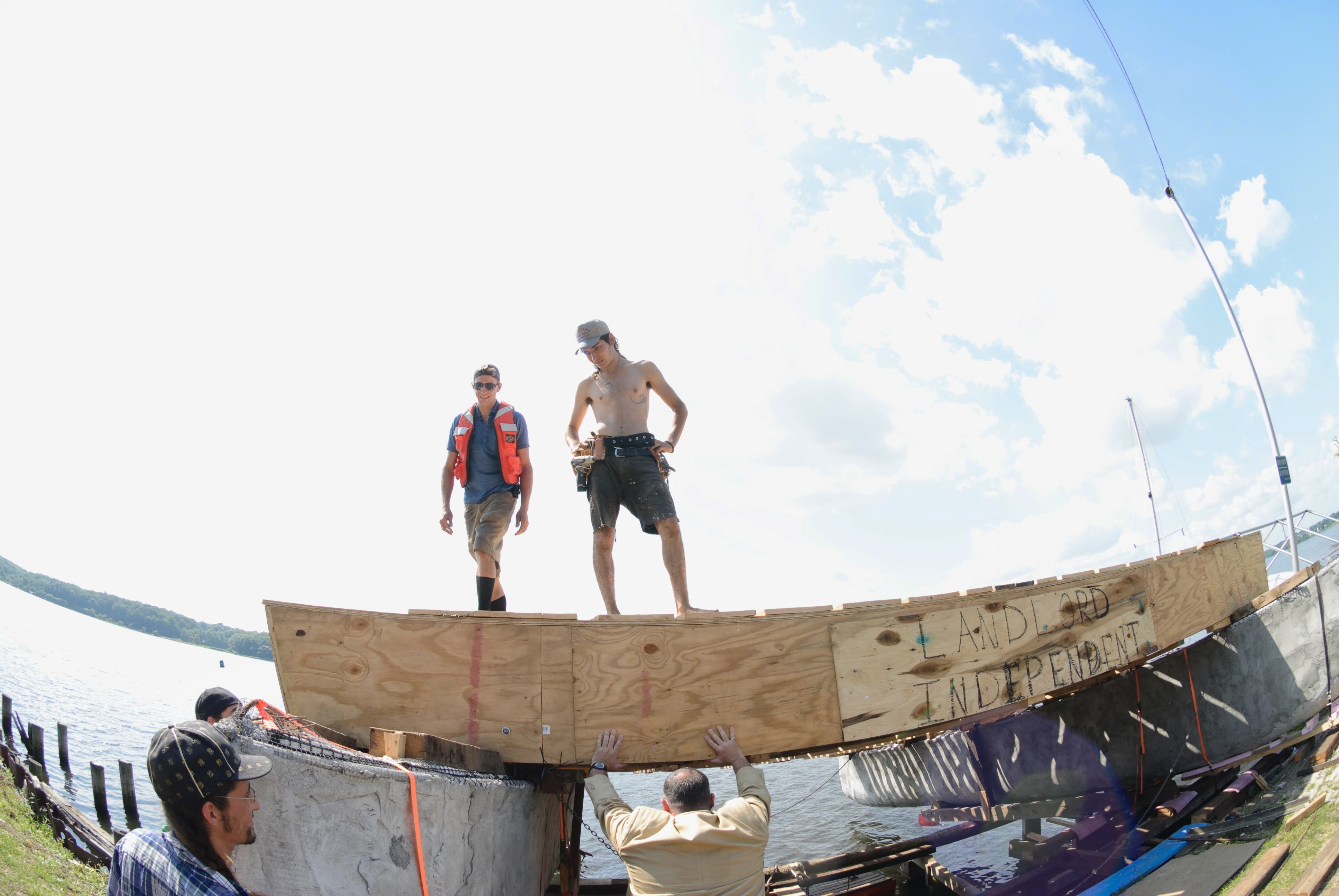

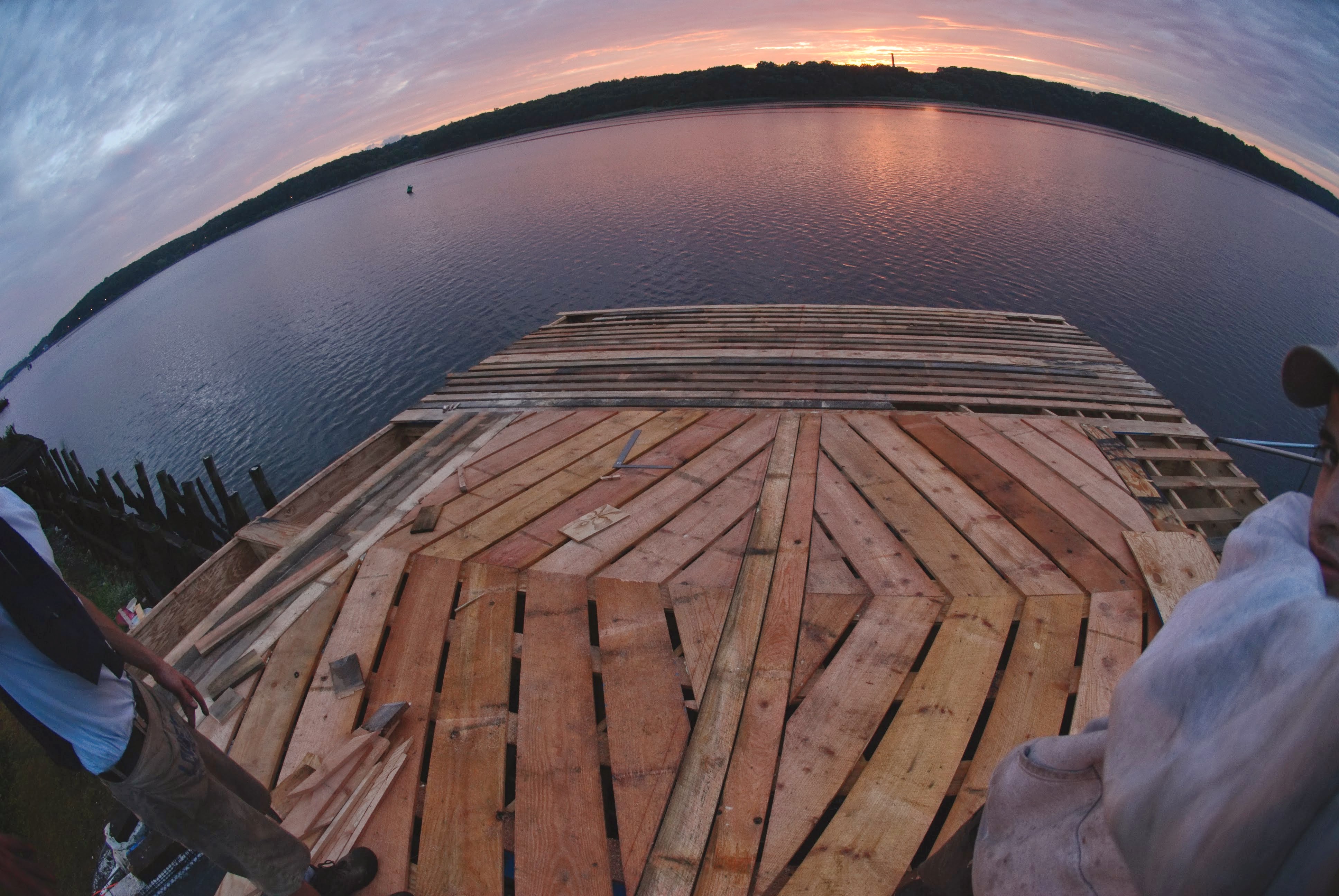
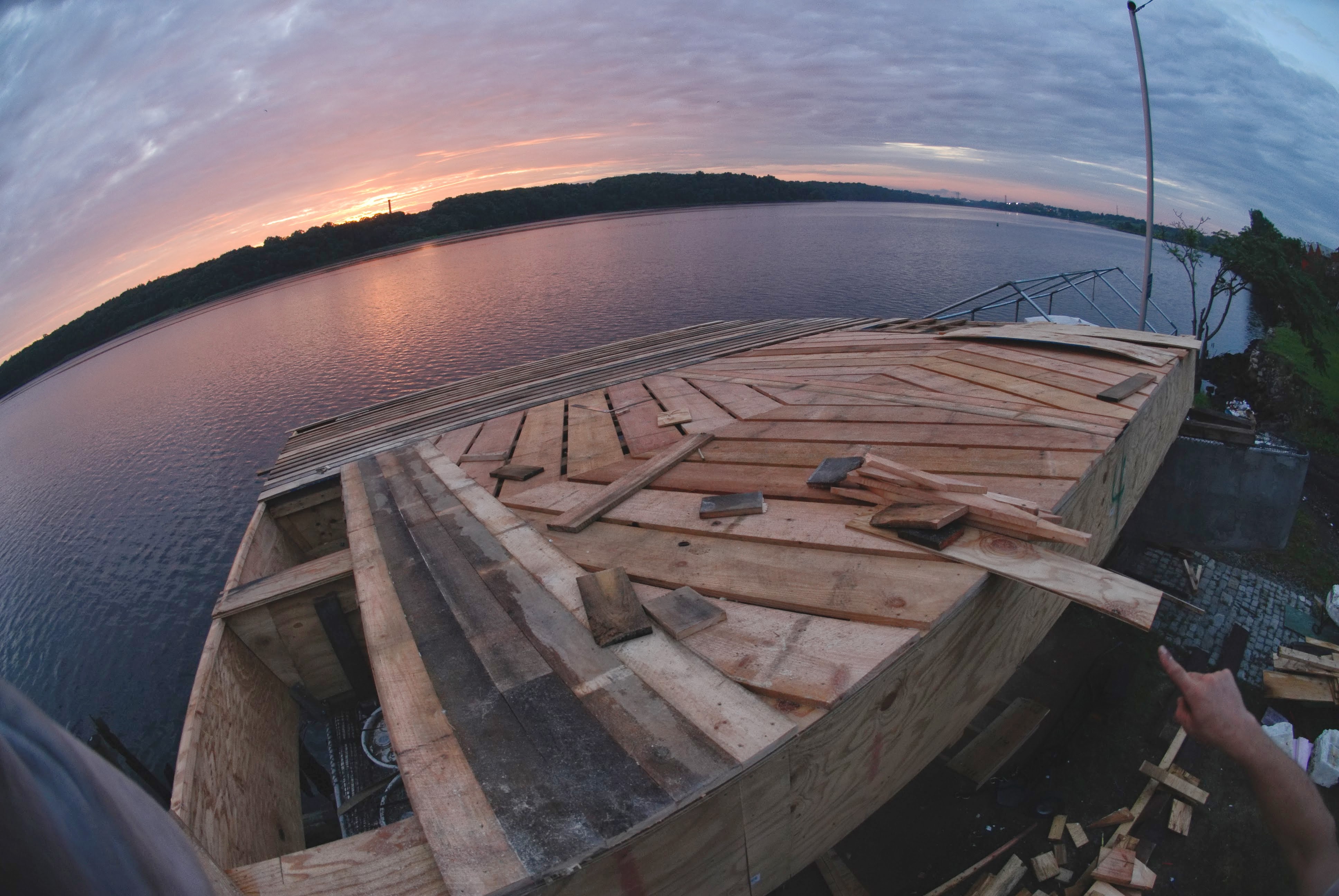


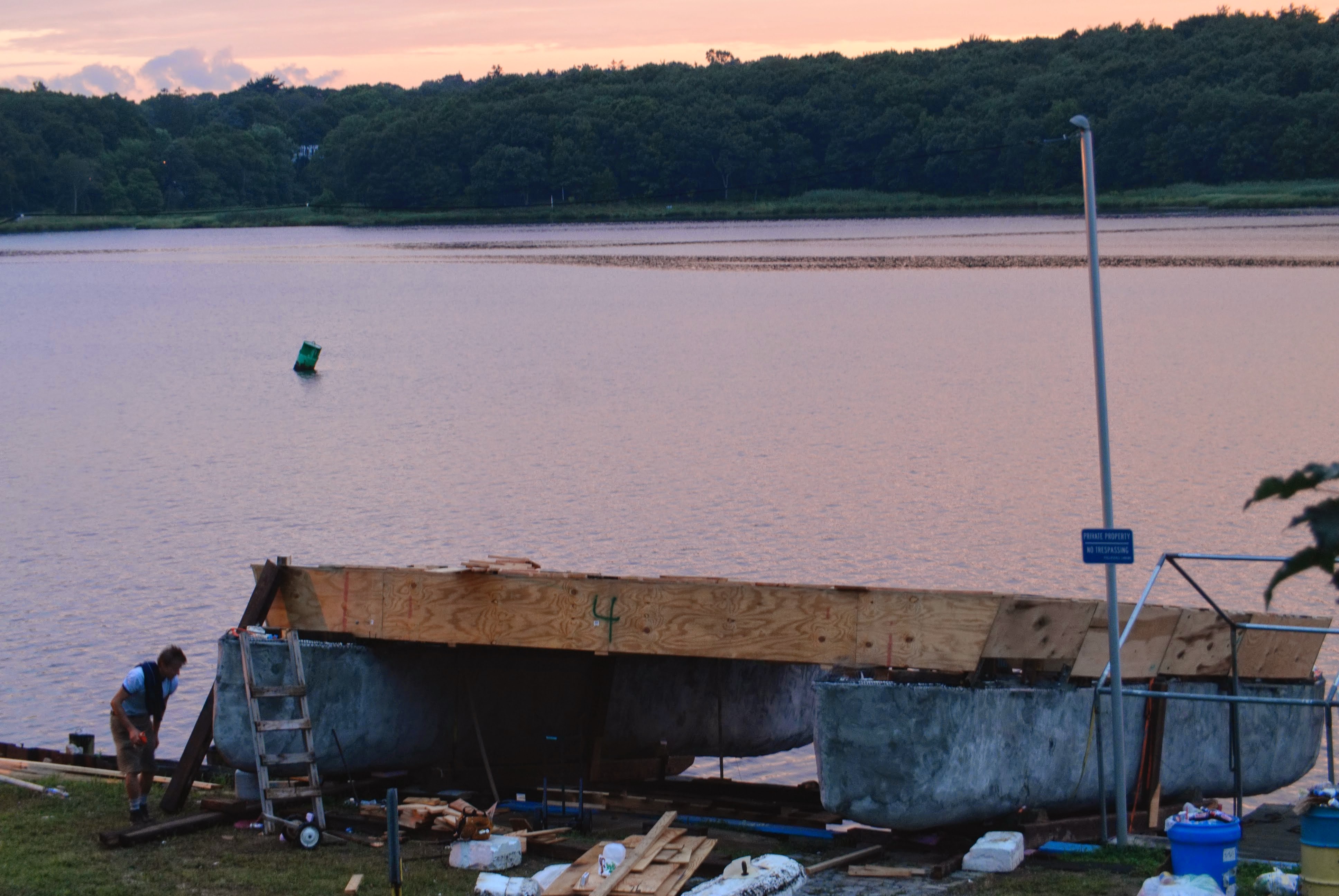

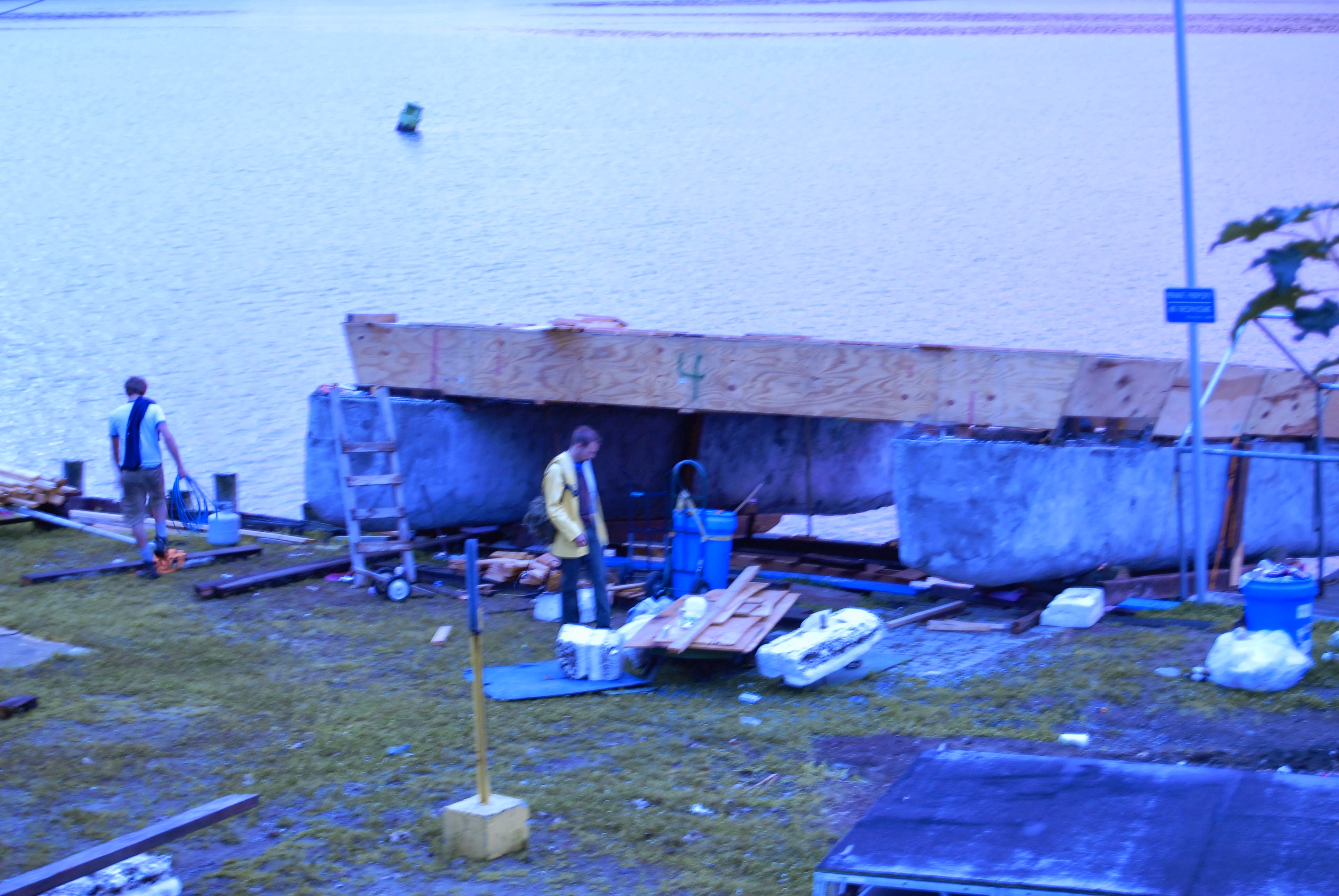
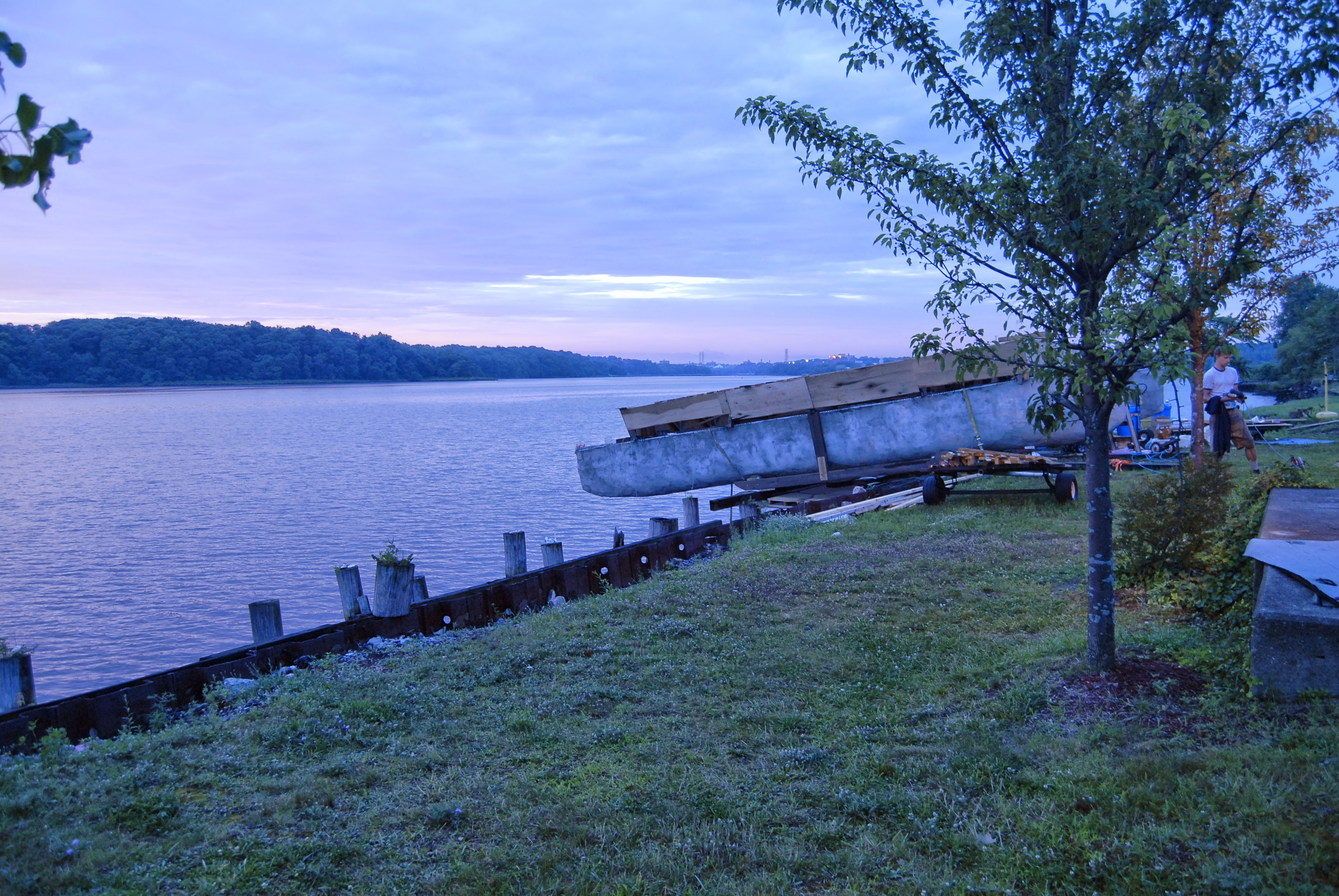


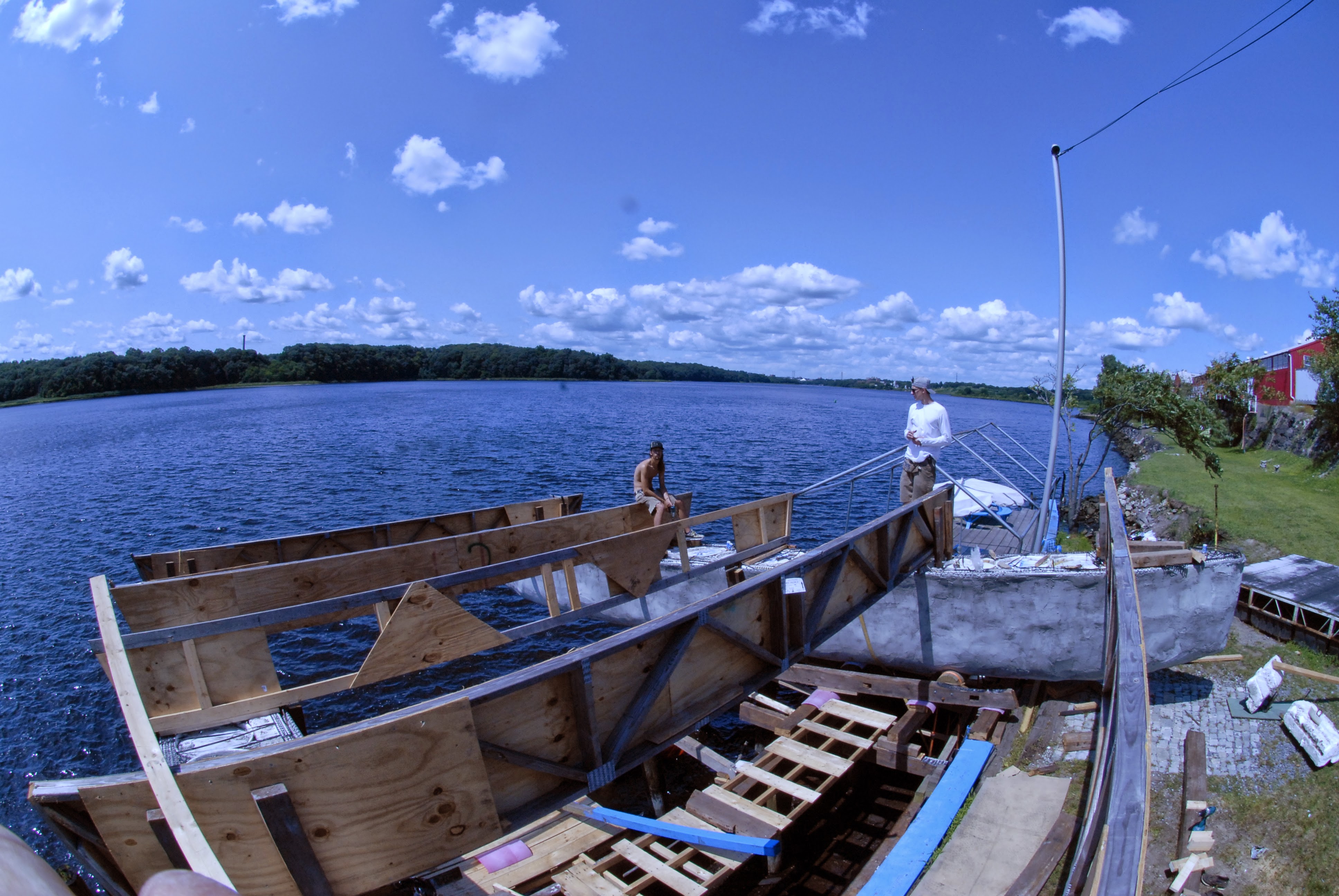

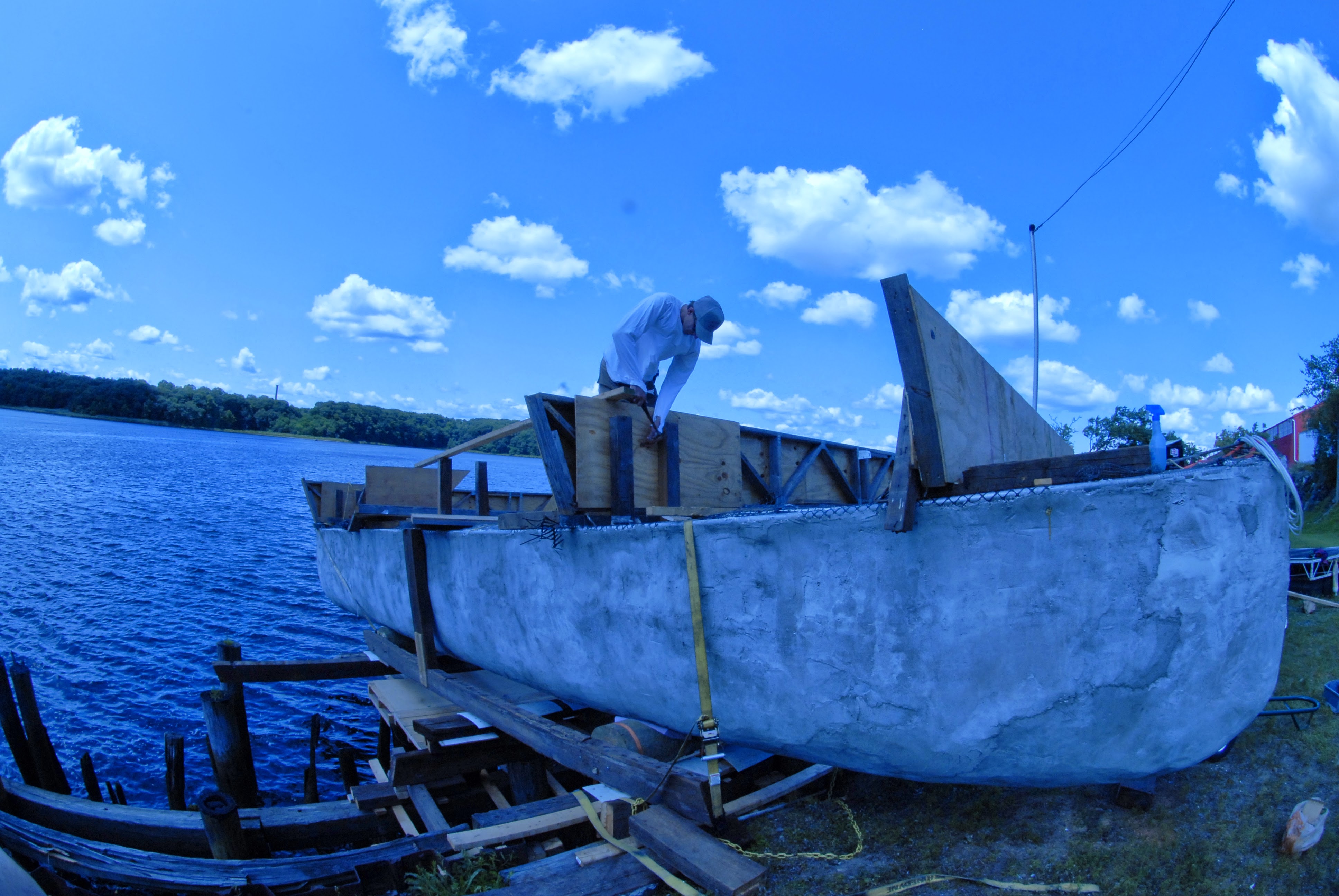

We used locally harvested and milled pine to build the boat’s 20x40 foot deck.
Launching
The system that held pontoons during the deck construction was designed to double as a ramp for the boat’s launch. With a crowd of family, friends, and reporters in attendance, we launched the boat into the Narragansett Bay.
Propulsion
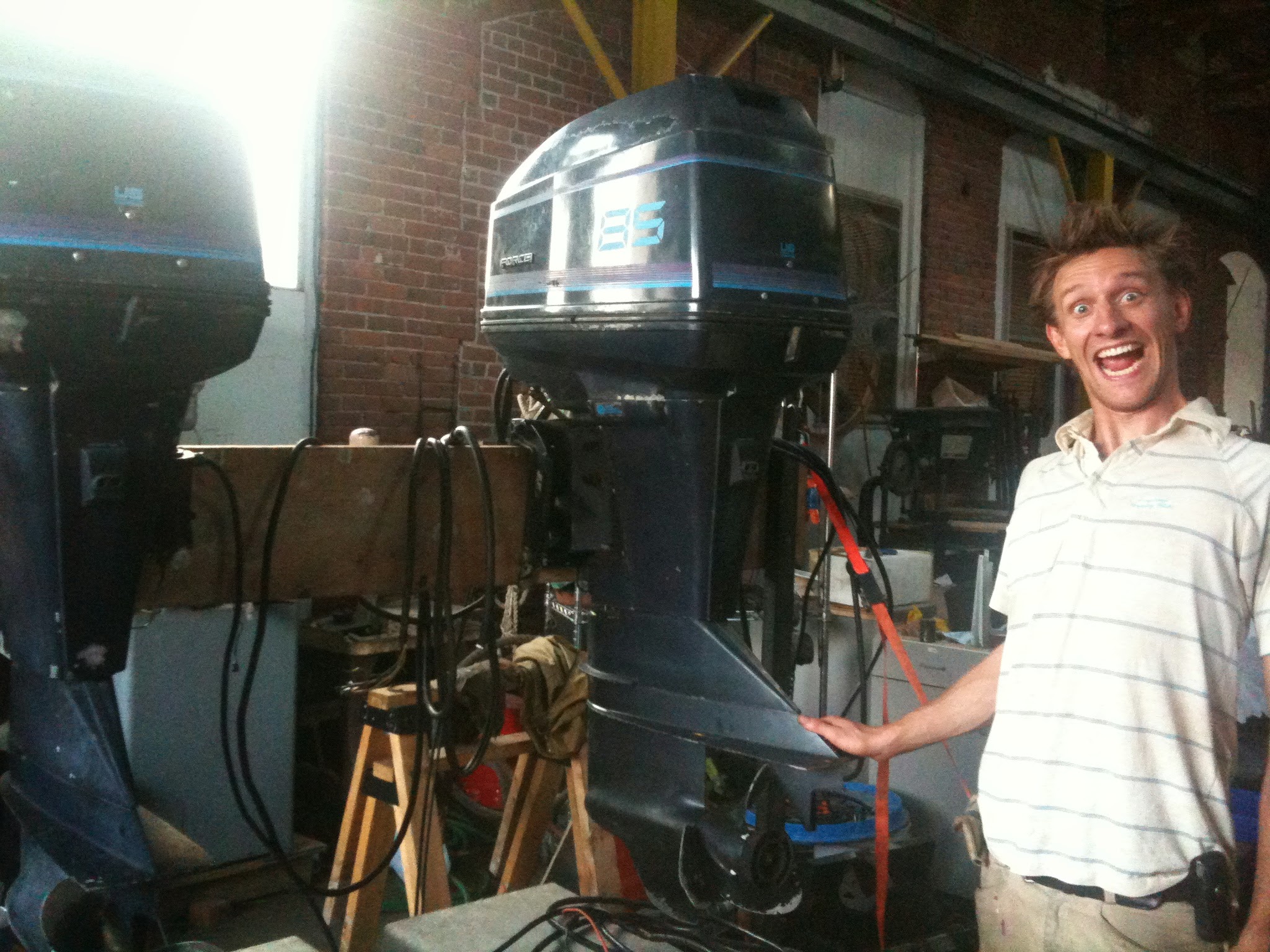
A transom was constructed for the vessel’s 85HP outboard motor. A pulley system was built so the motor could be controlled by a bicycle steering wheel above the deck.
Constructing the Ponotoons


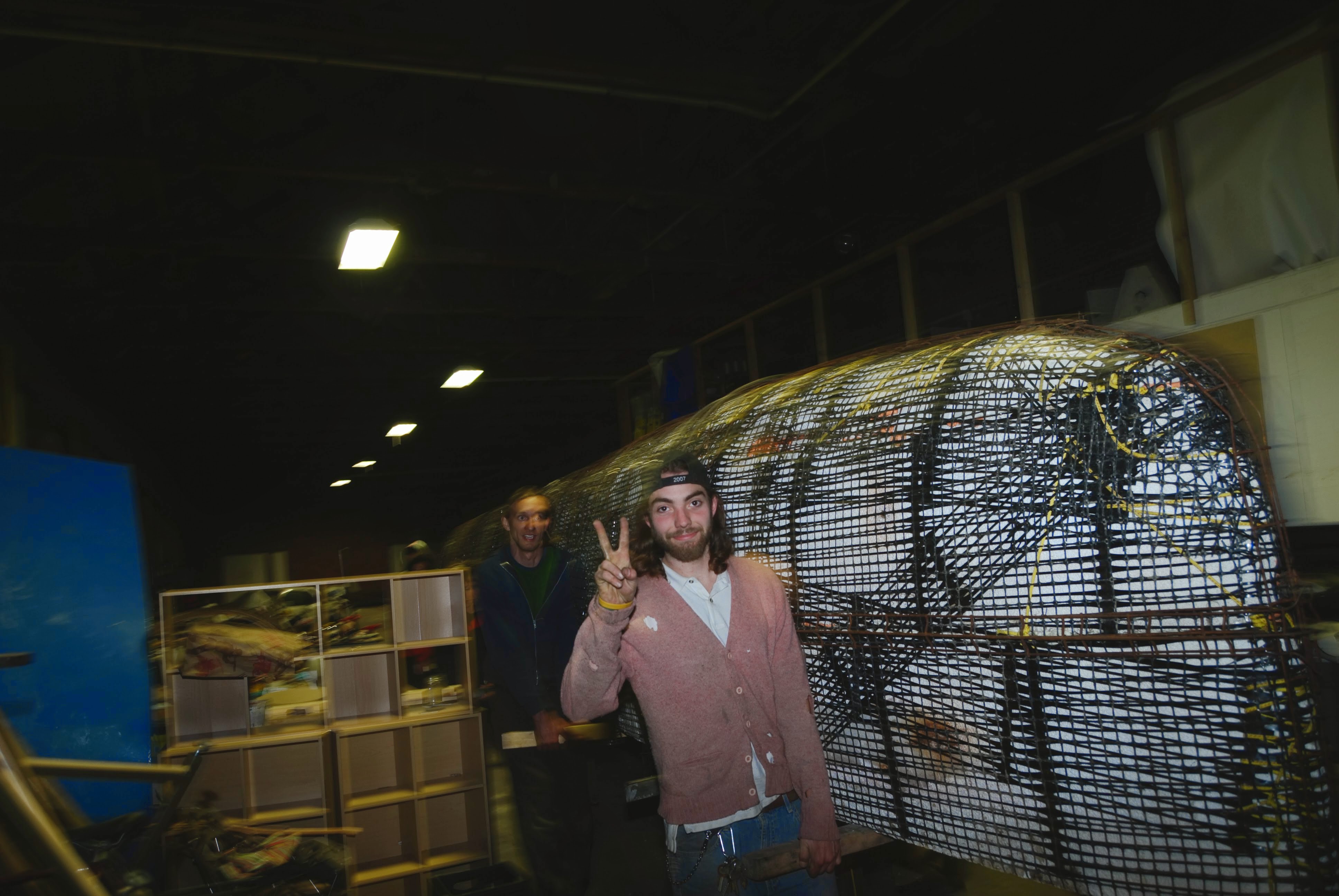


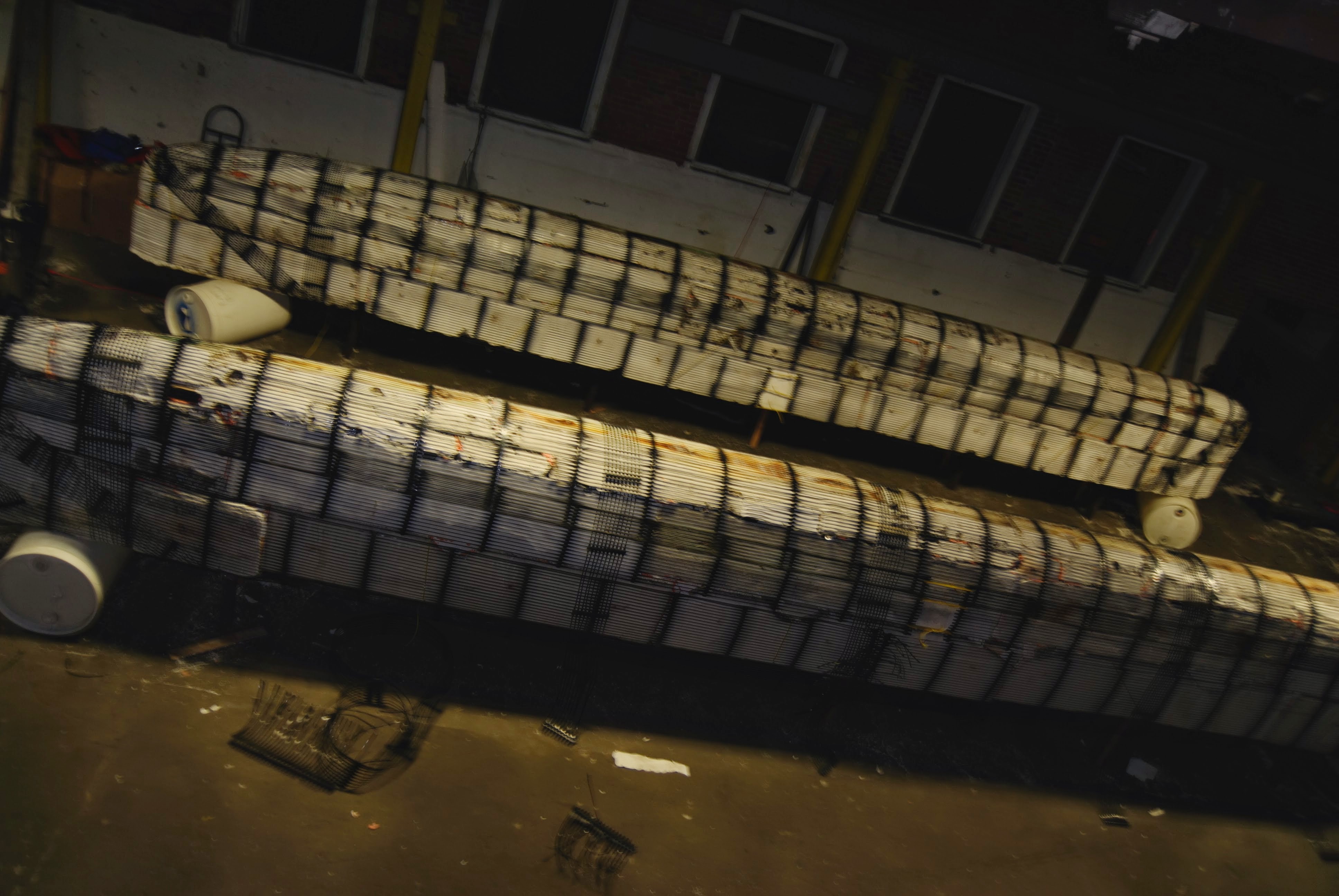


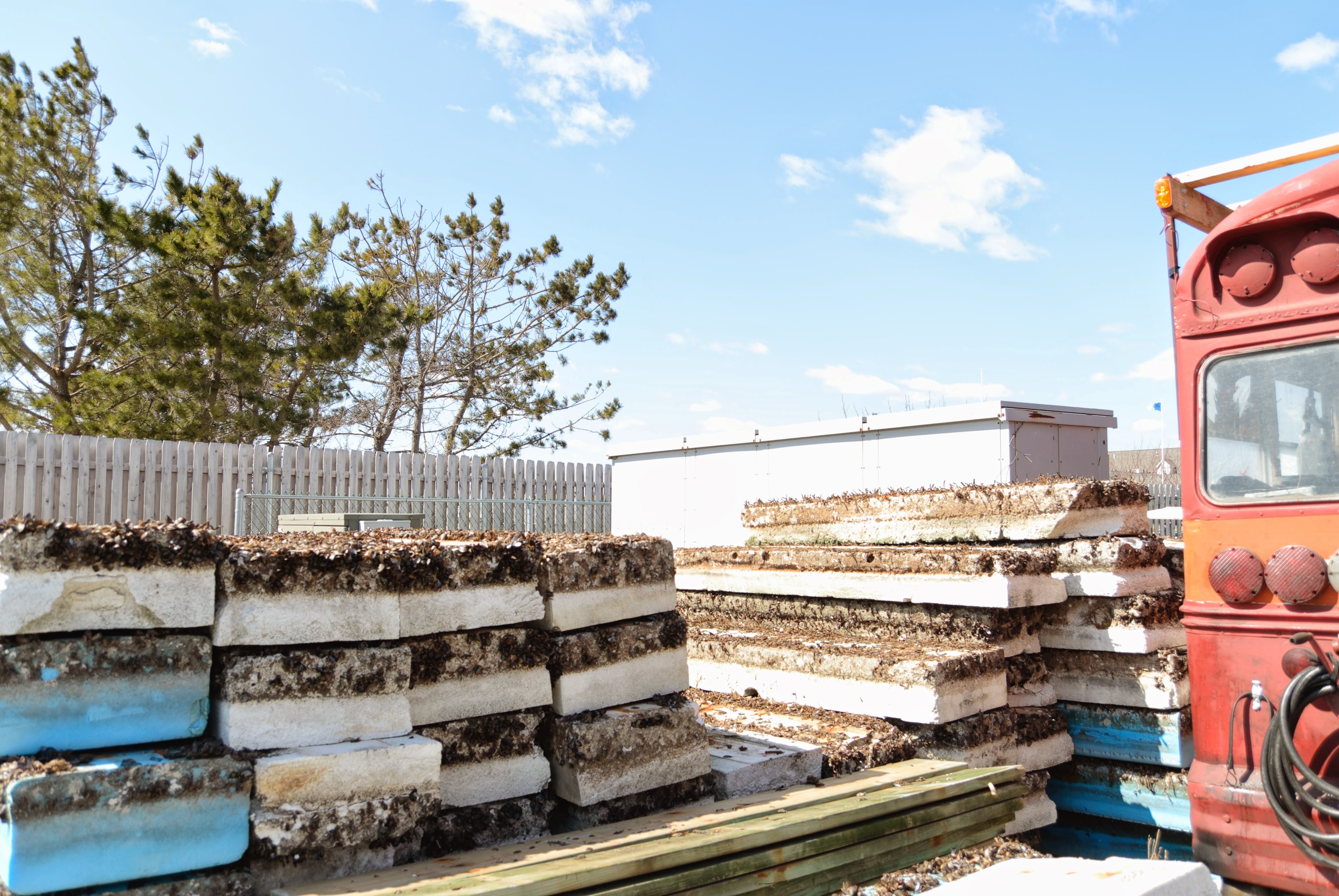


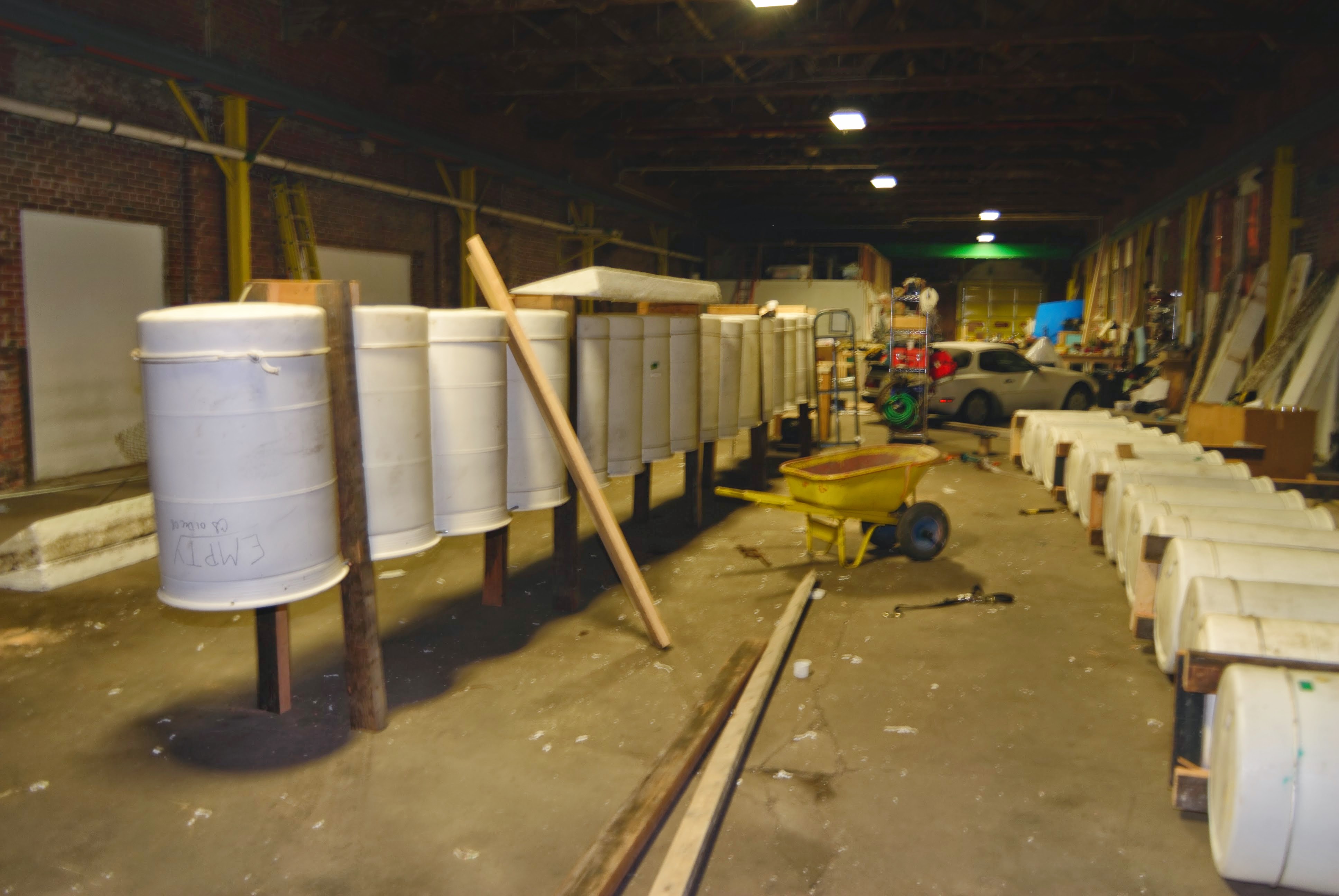


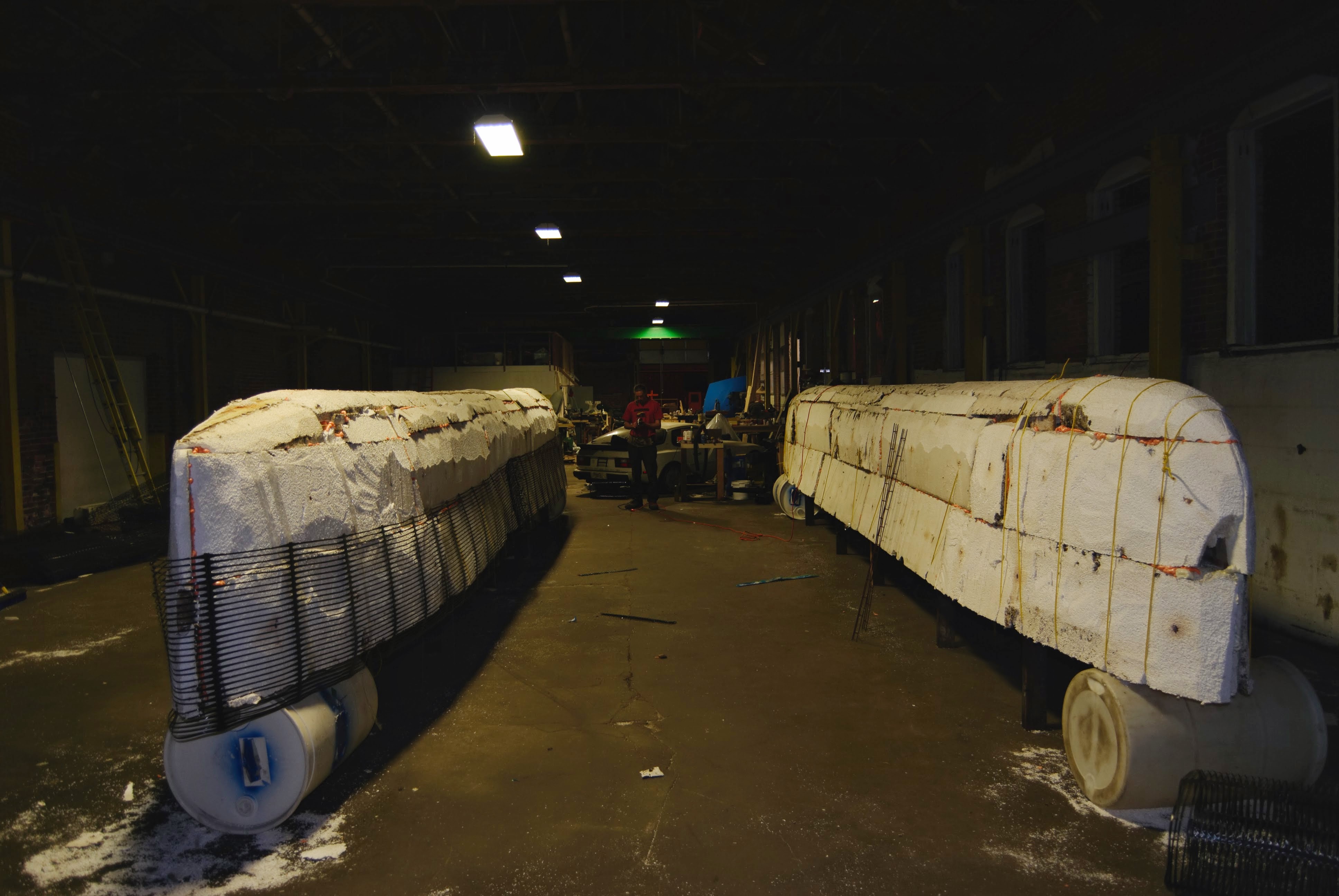
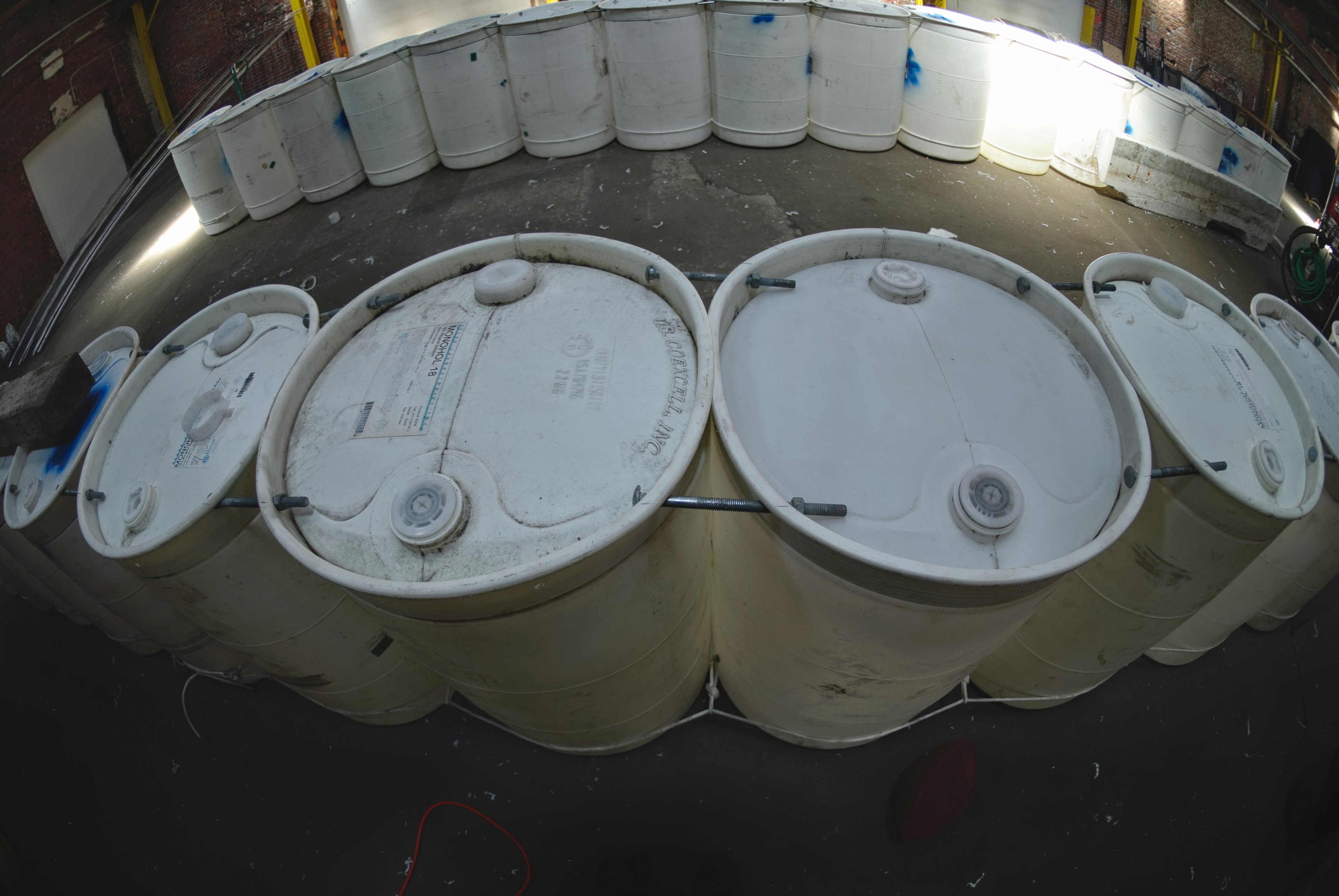


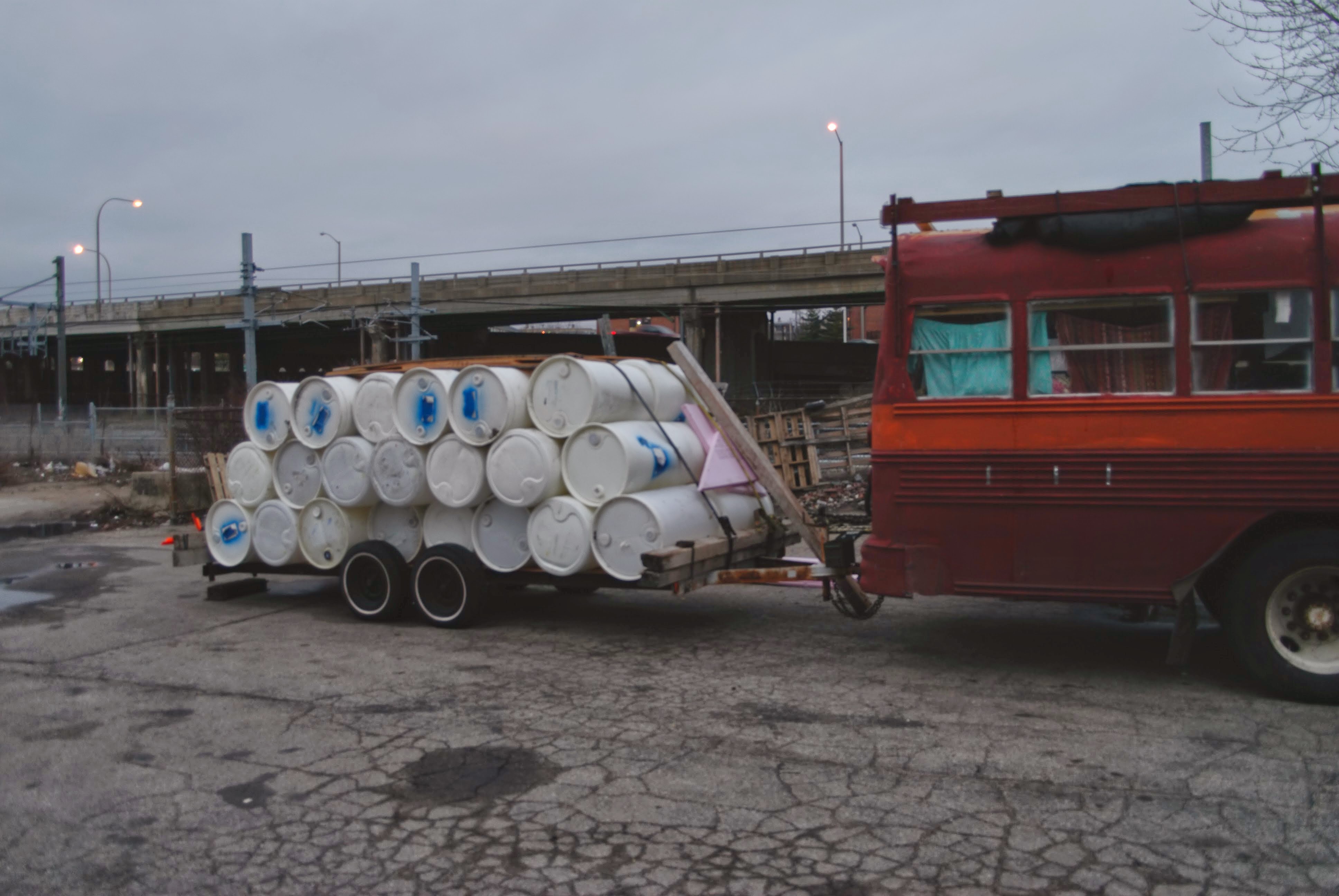
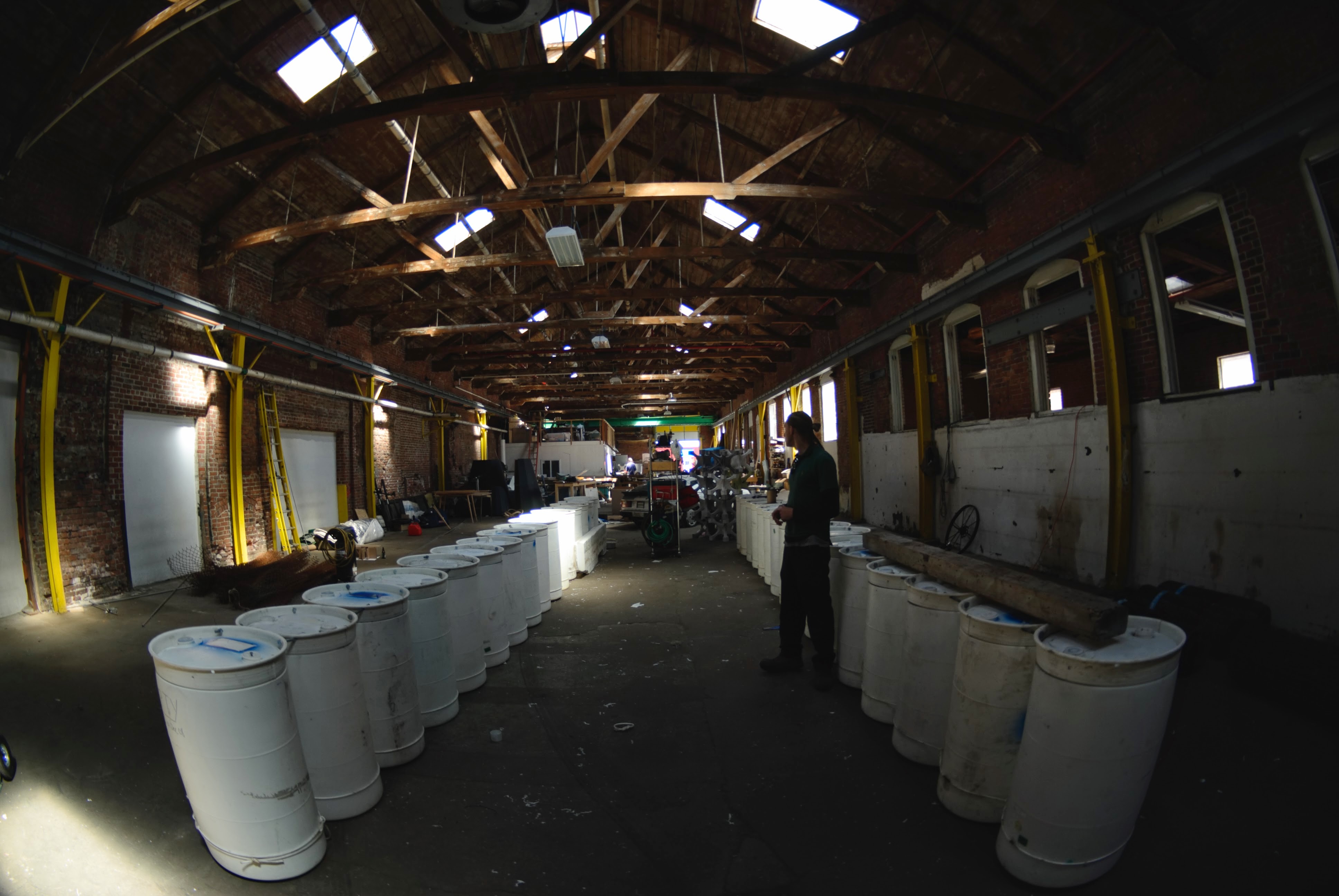


Pontoon materials
Two local businesses donated the materials for this phase: 32 polyethylene barrels from a pharmaceutical company and 800 cubic feet of dock foam from a nearby marina.
Shaping the pontoons
The internal structure and external shaping of the pontoons was completed inside our warehouse space. Once the pontoons were prepared for a skim coat of concrete, they were moved to an outside construction site. Roughly 20 people were required to lift each pontoon.
Skim coating in concrete
A custom mix of Portland cement, sand, and plastic aggregate was used to for an abrasion resistant coating. Once completed, bottles, jacks, and pulleys were used to carefully rotate the pontoons for transportation.
Transport from Construction Area to Launch Site
A truck axle was used to move these one-ton pontoons from the initial construction area to the waterfront. Unused dock pilings were utilized to build a system that held pontoons in a square position.
In the News
- “Boat Livin'” The College Hill Independent
- “Weathering the Storm” The Providence Journal
- “They're Floating an Idea for Sustainable Living” The Providence Journal
- “On the Water and Off the Grid” The Providene Phoenix
- “Makers of Sustainable Vessel Fight to Dock in Providence” Rhode Island Public Radio
School Bus (2009)
Equipping and traveling in a vegetable oil powered school bus.
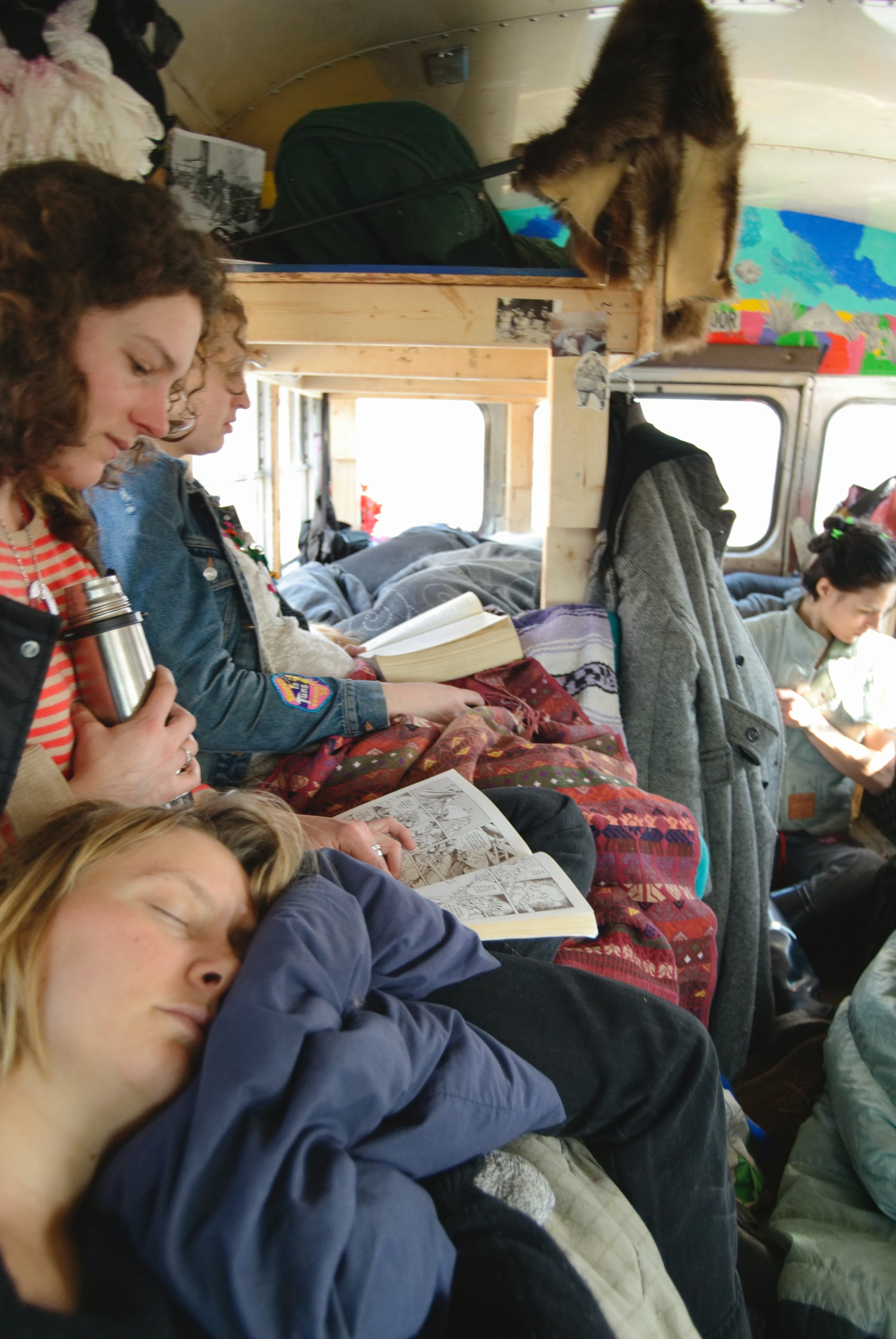
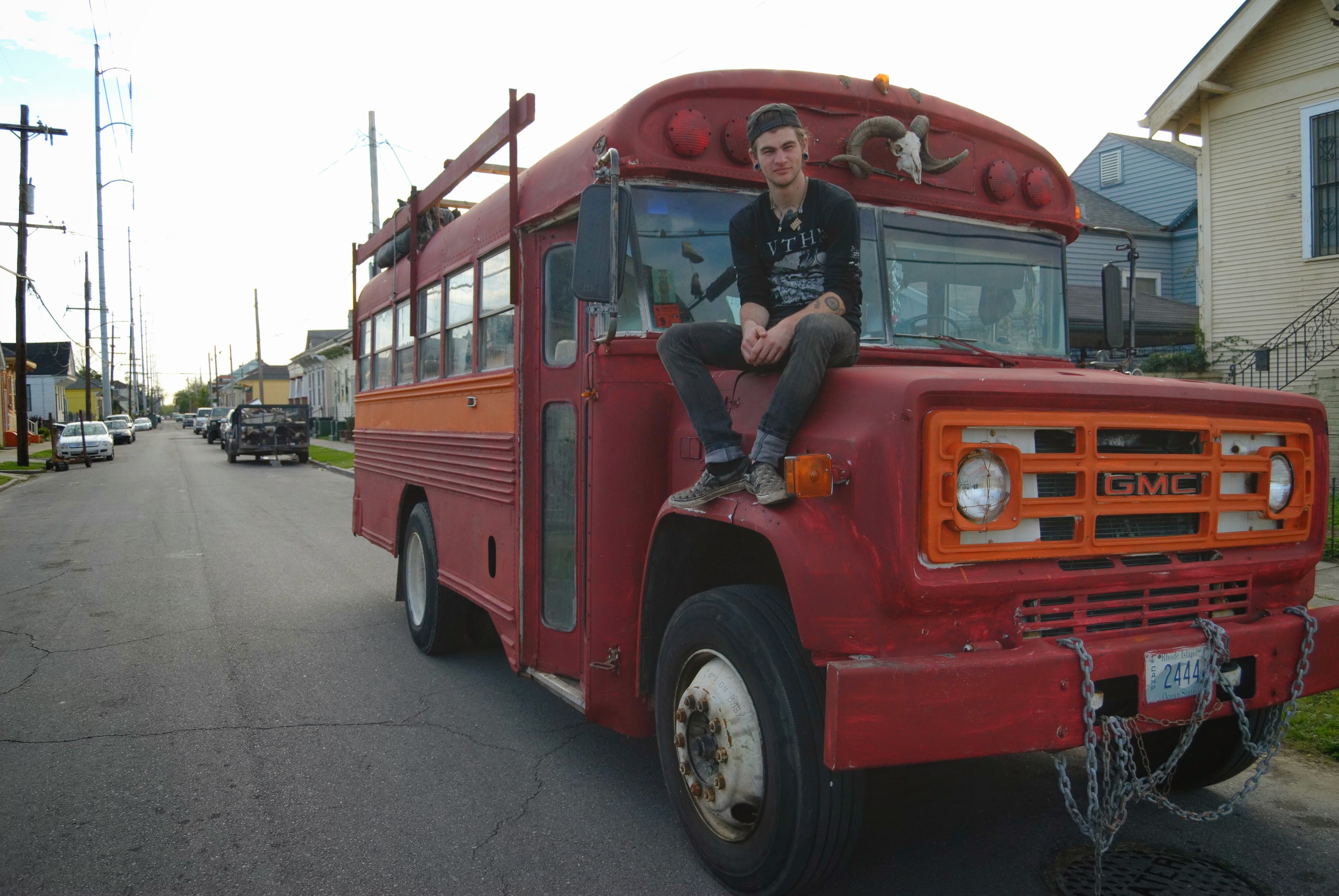
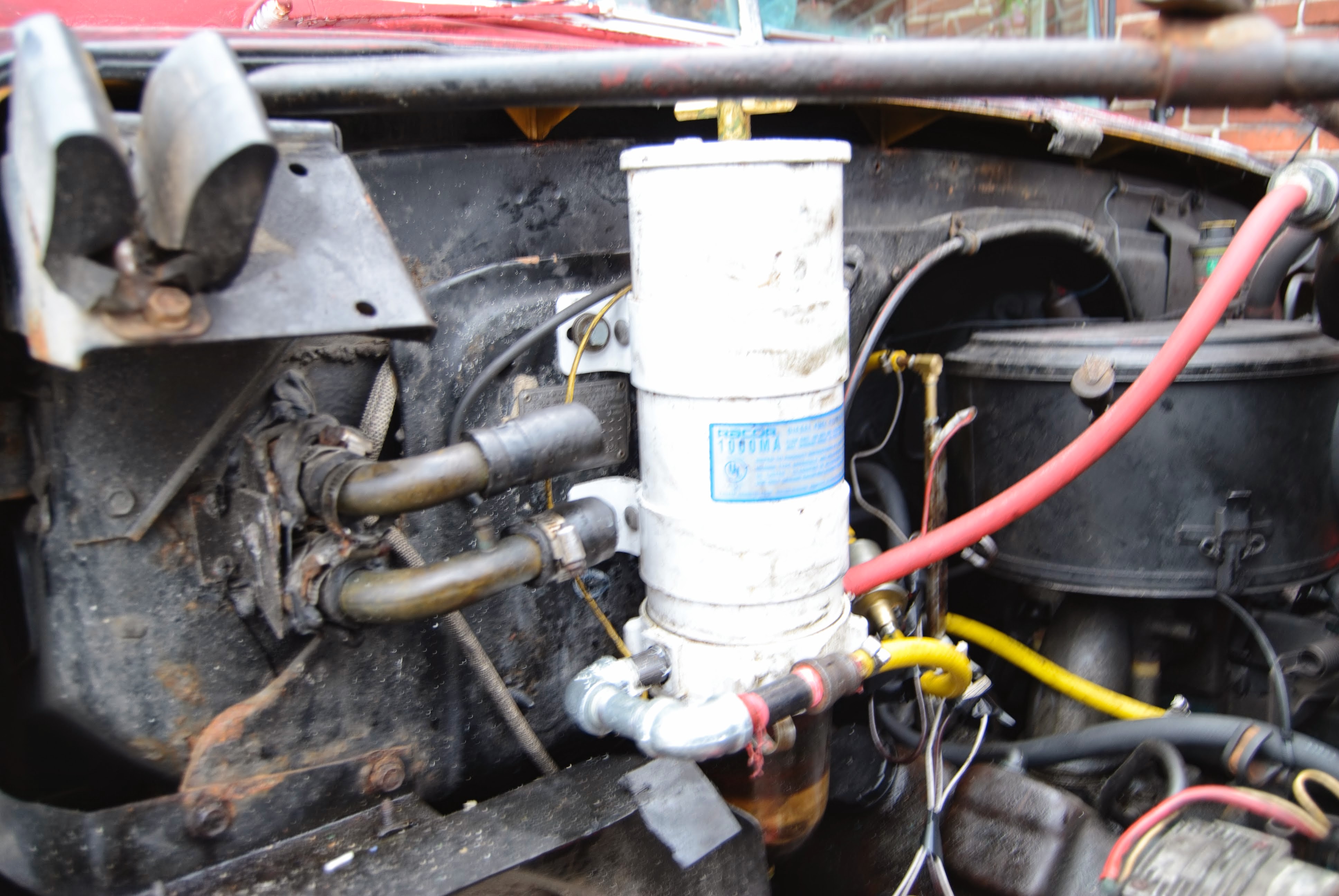
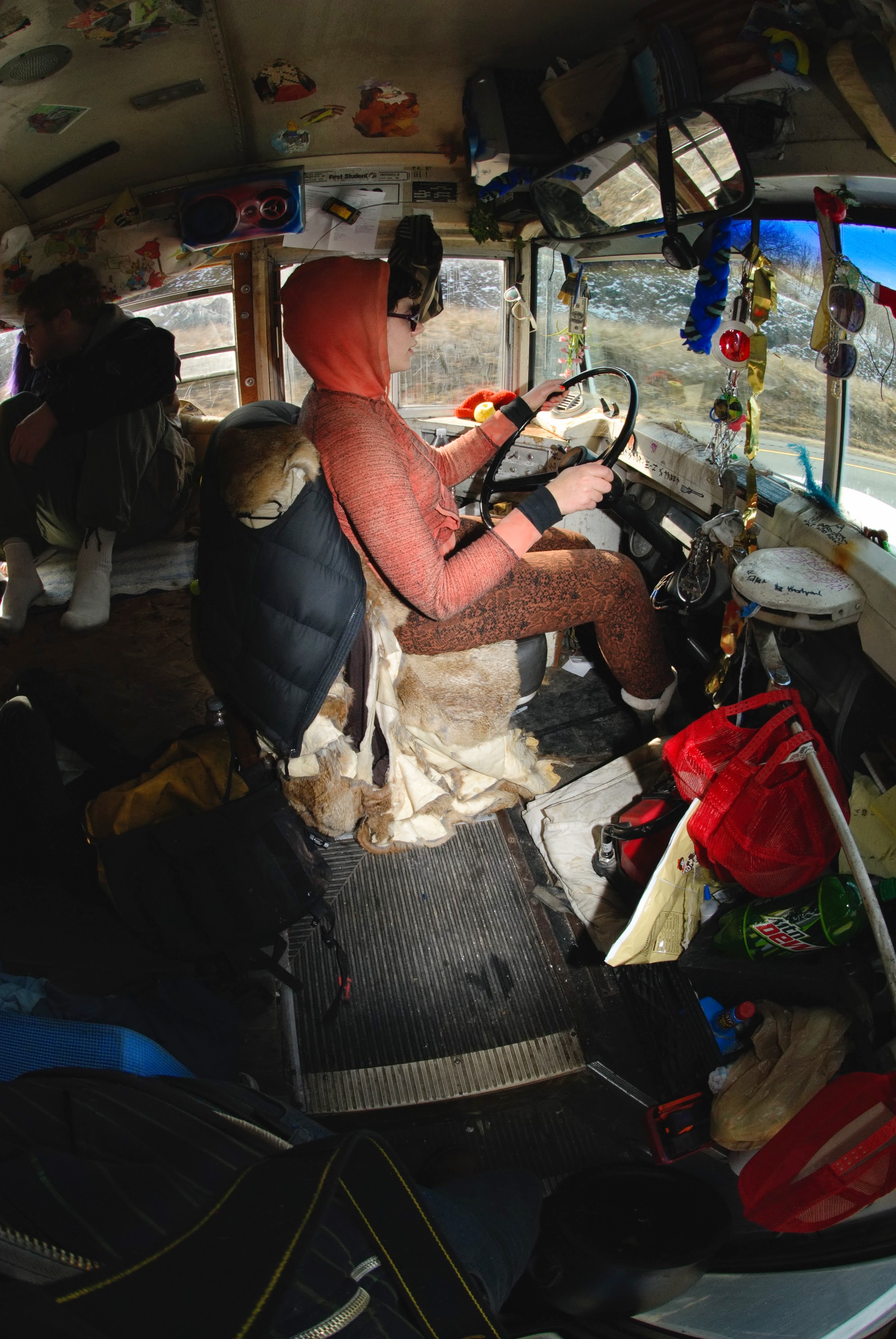
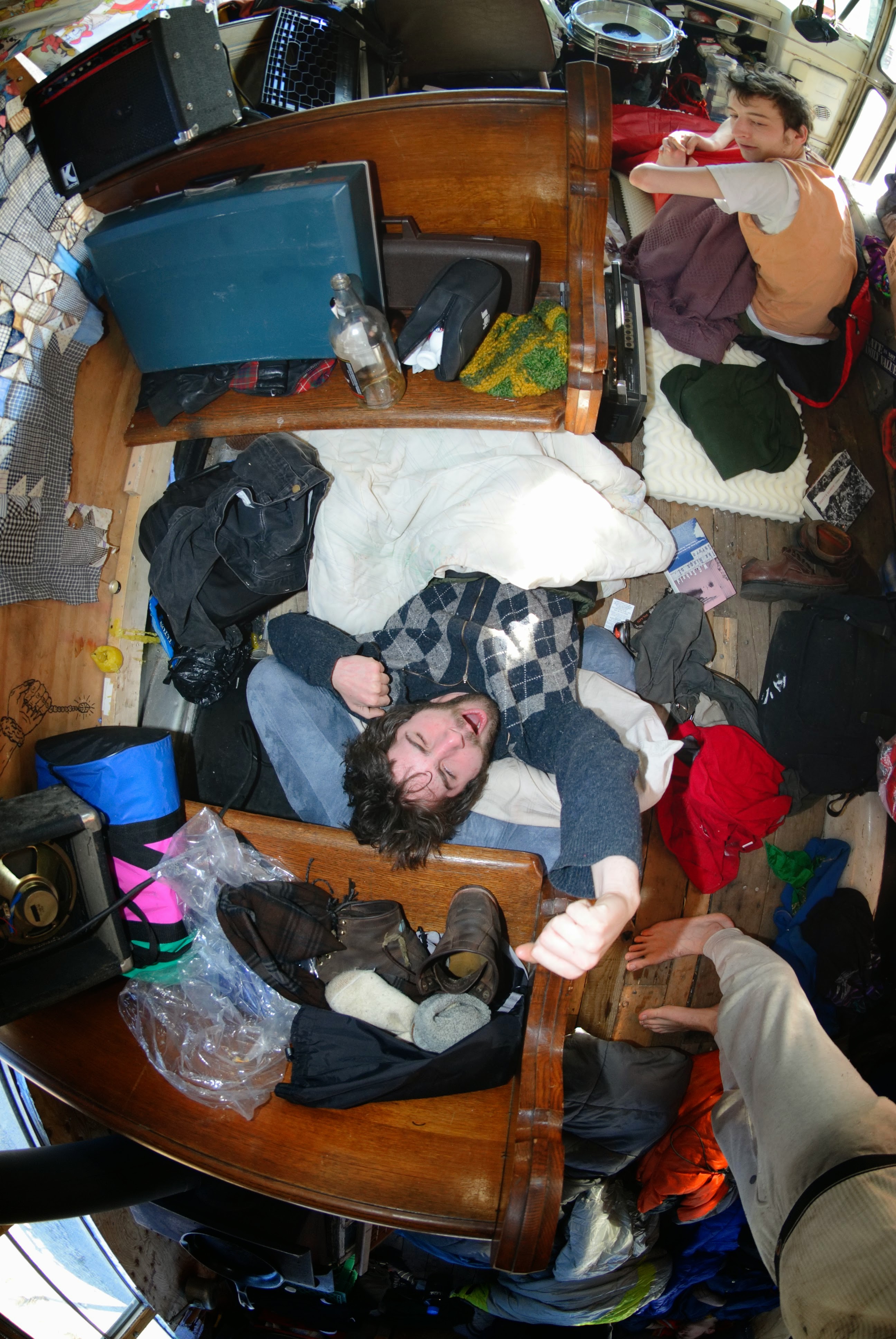
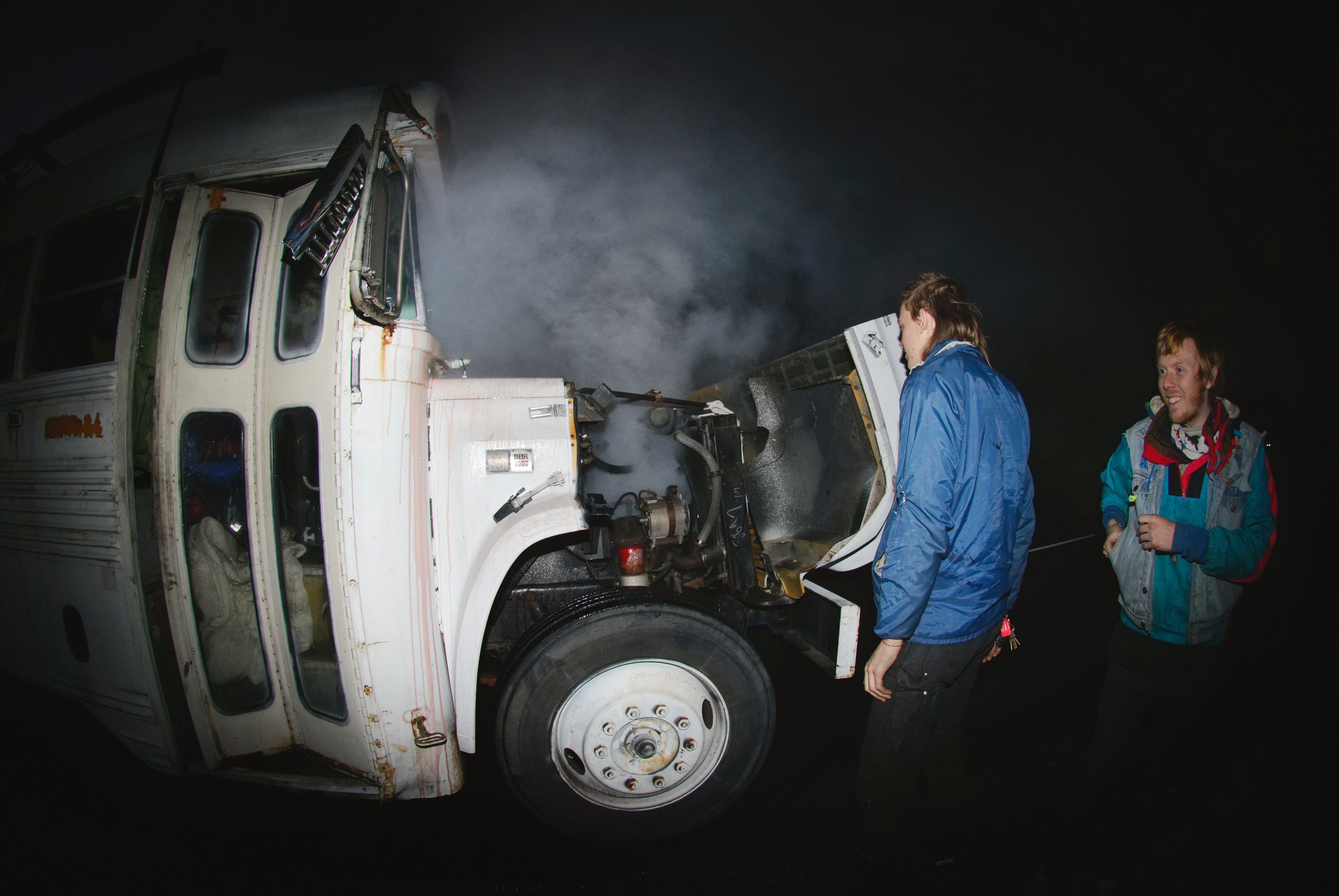
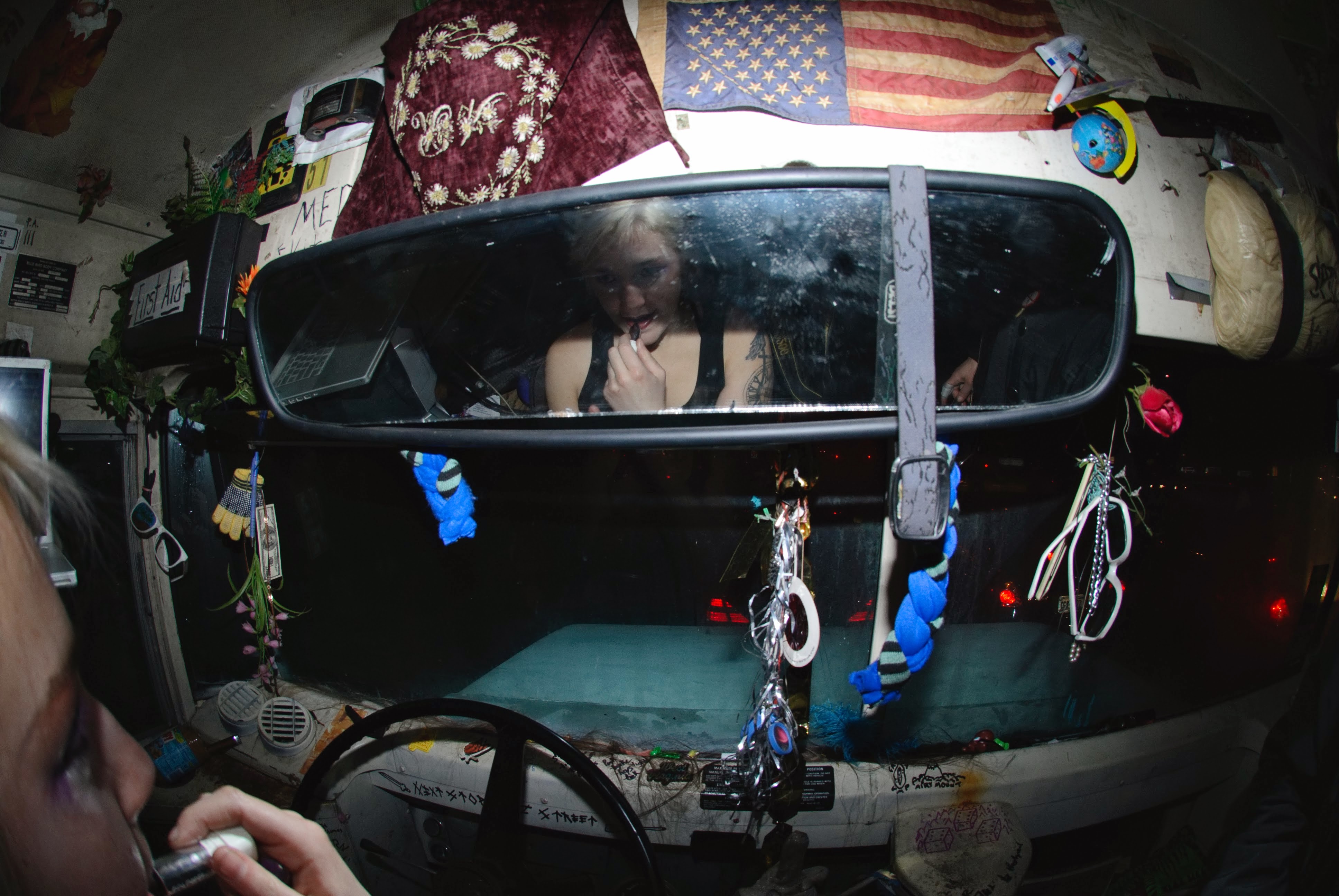
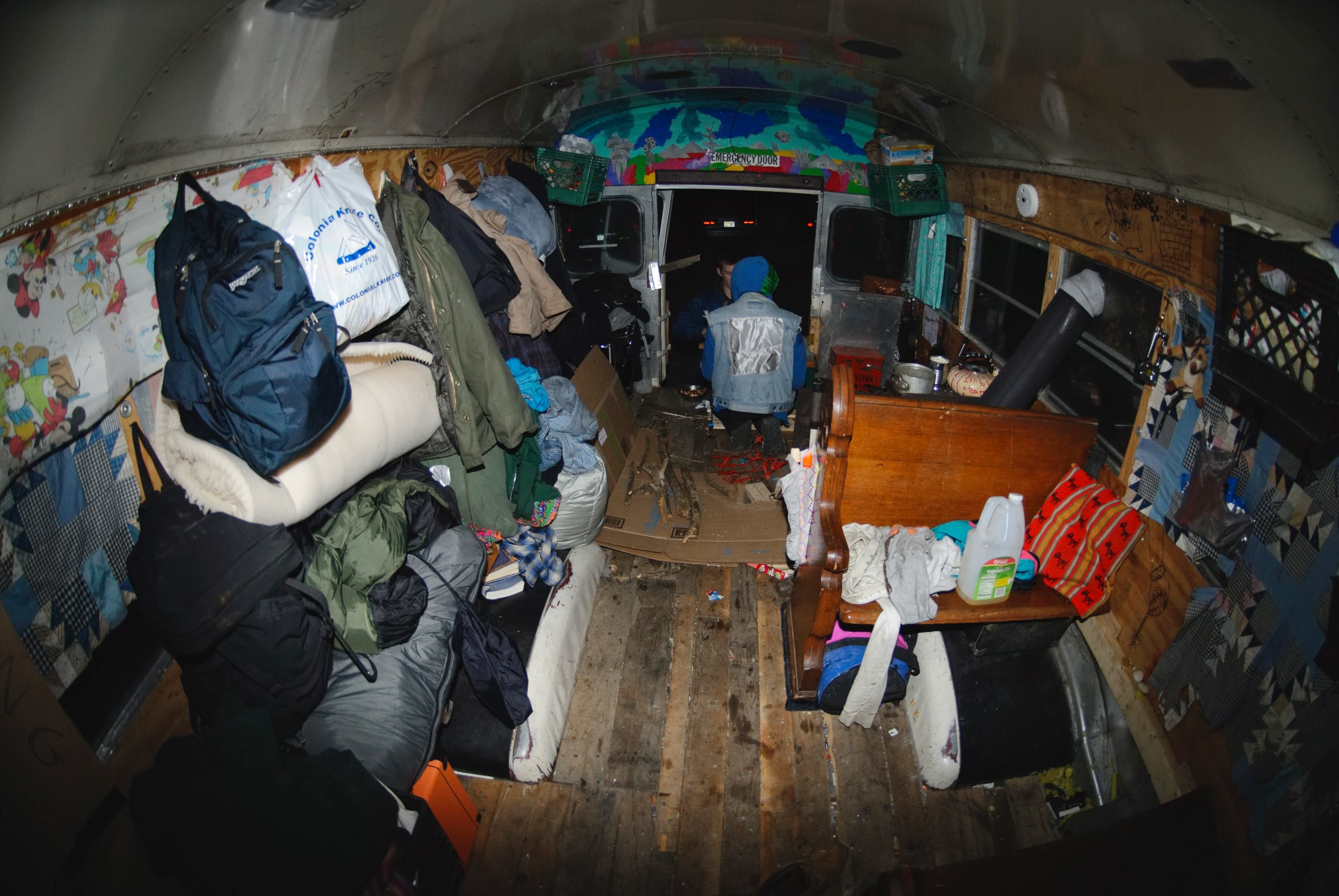
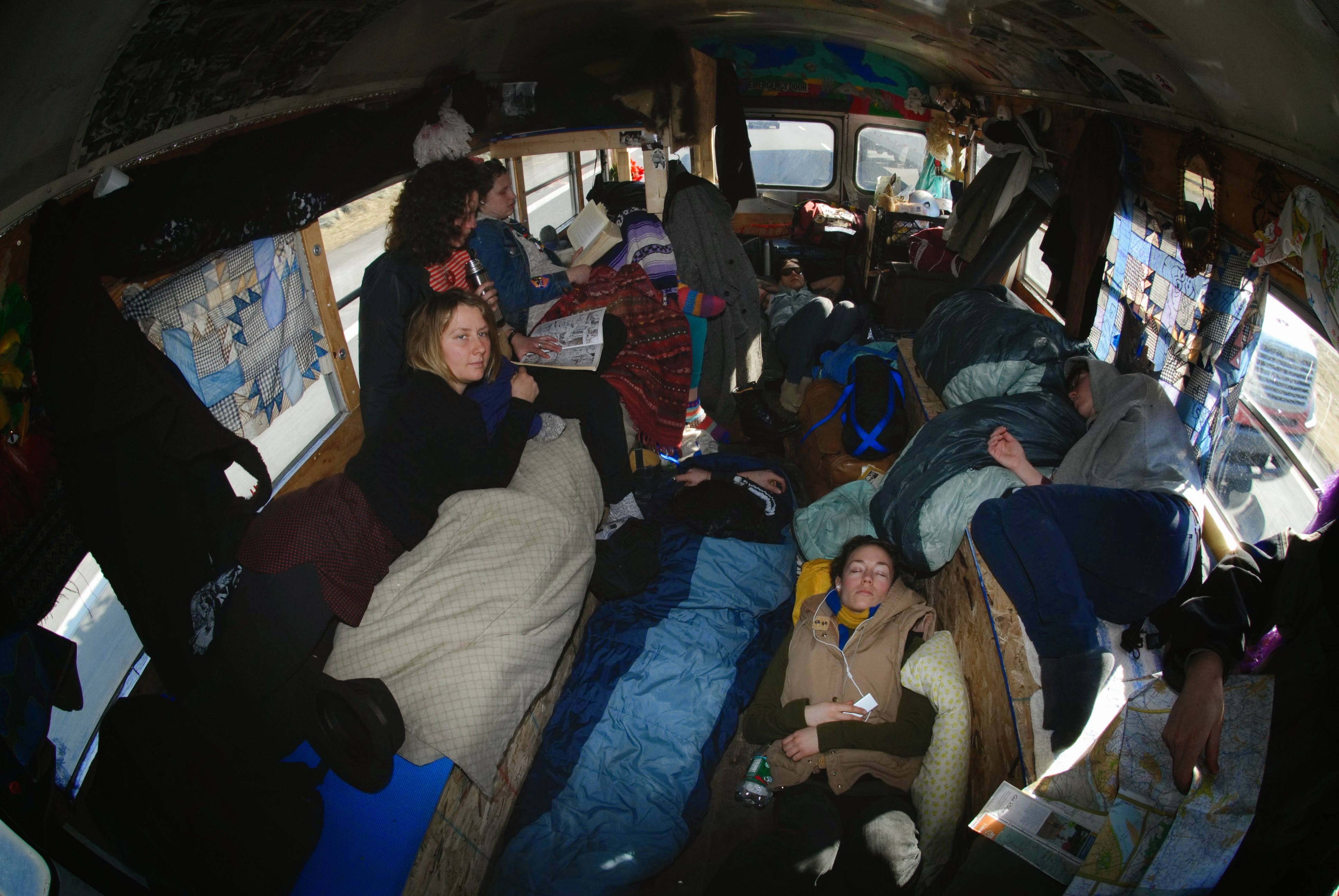
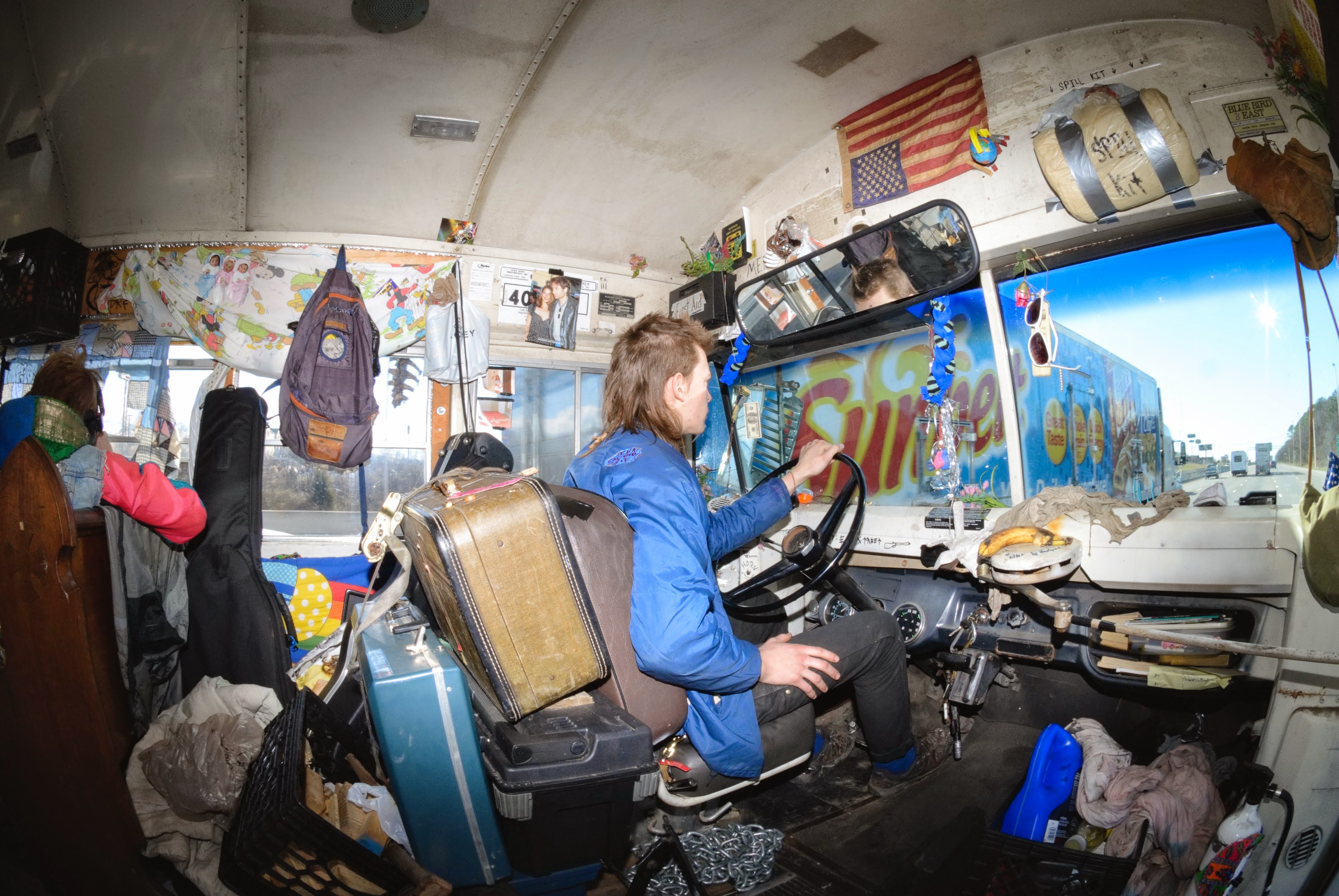
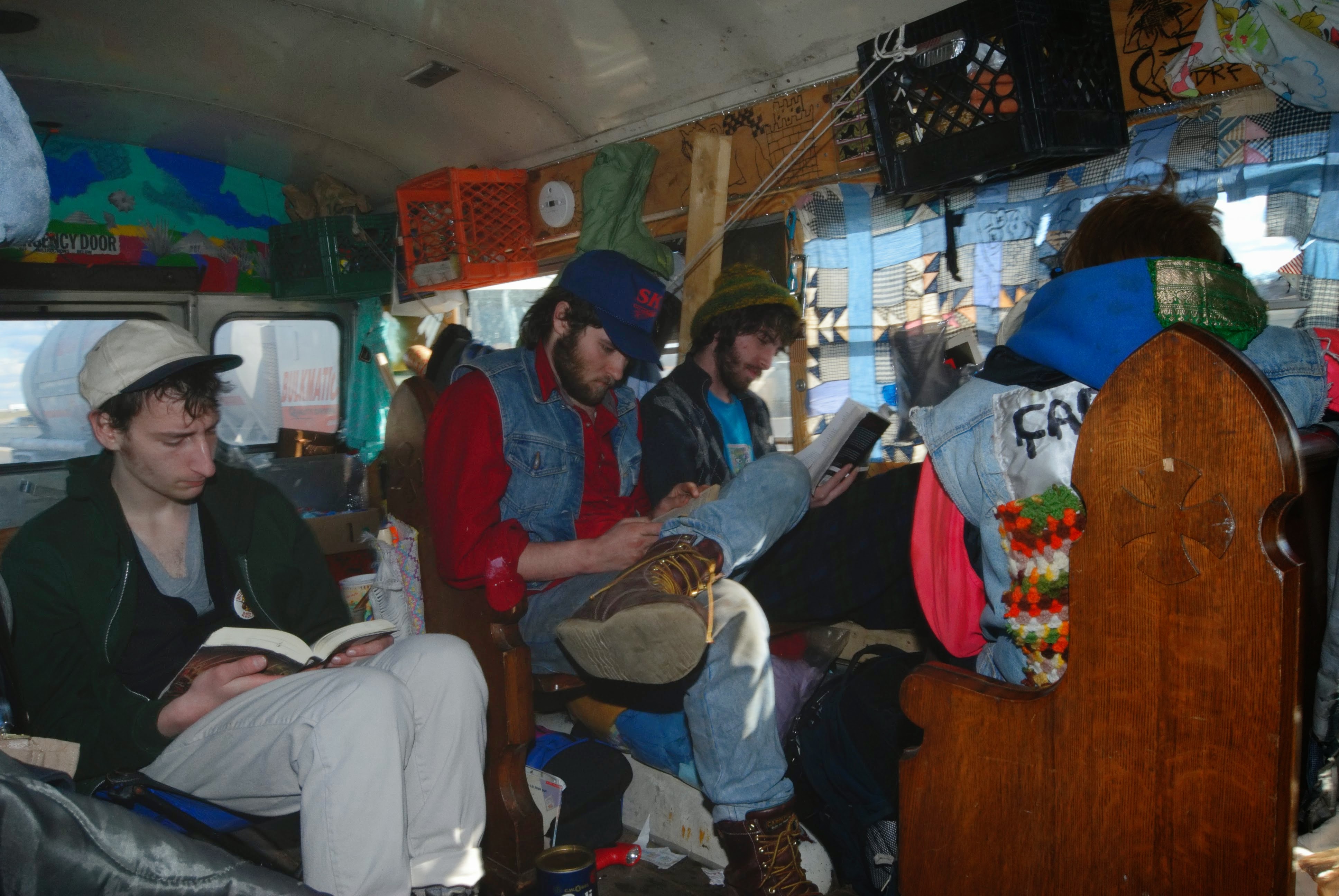
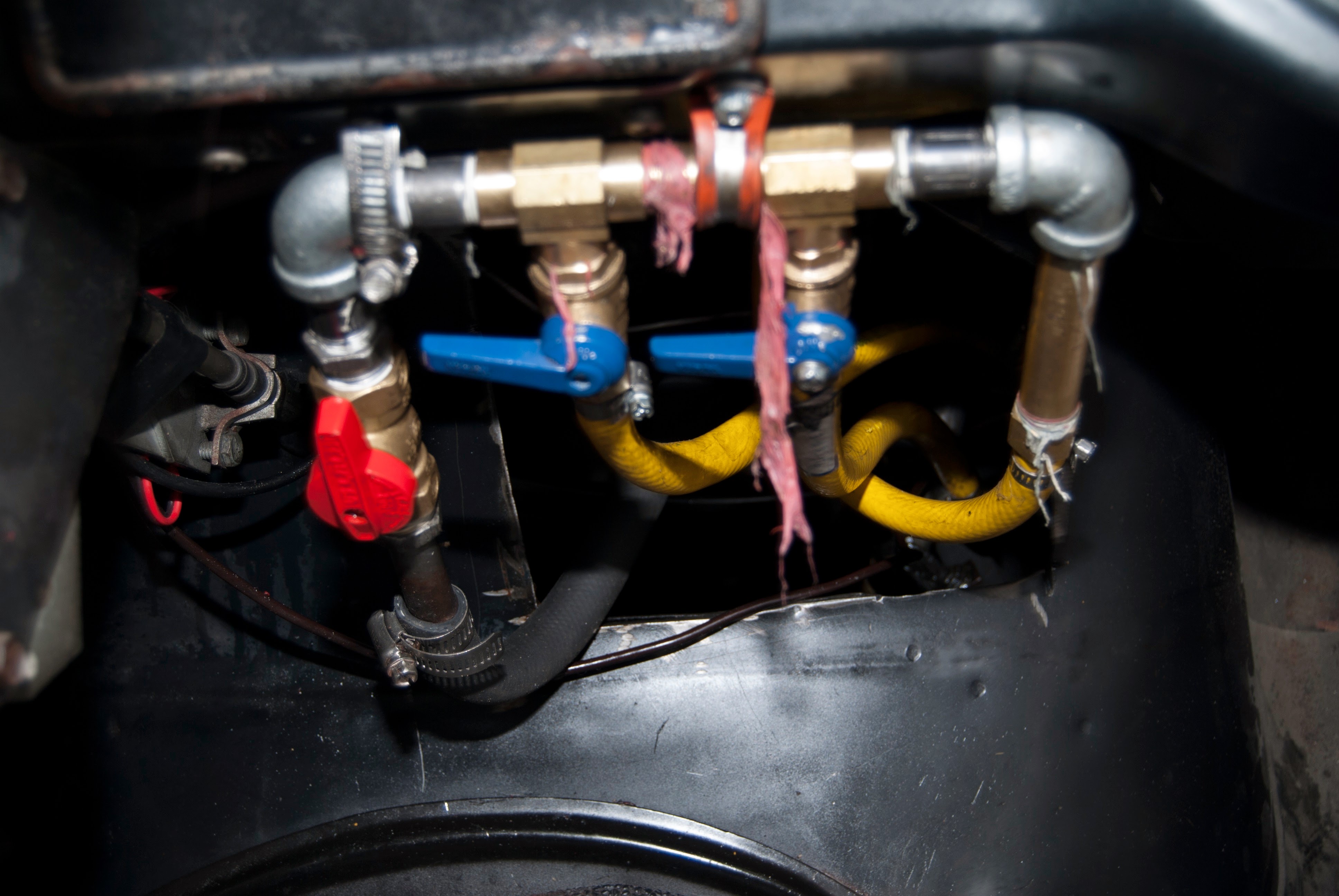
I purchased this 1989 GMC school bus for $500 in the fall of 2008 and modified it to accommodate passengers for a series of road trips. As I traversed the country landscape, the need for fuel efficiency and greater self-reliance became increasingly evident. To this end, with the help of a few friends I designed, built, and installed a system for running the bus’s diesel engine on waste vegetable oil; a free and abundant resource that I collected from roadside restaurants.
The following photographs provide a sense of its various parts, passengers, and purposes.